Jesus answered: ‘Will you lay down your life for me?’ - John 13:38

Support the Holy Father and pray with him!

"Young people in particular, I appeal to you: bear witness to your faith through the digital world!"

-Pope Benedict XVI

Pray for Pope Benedict's prayer intentions for this month. Find out more here.

Tuesday, October 7, 2008

Keep it up!!!!!

I was so surprised and delighted to receive this mail today. Keep blogging guys!! And keep Sister Frances in your prayers!

Hi Brother Dominic and Sister Carina,

I happened upon your blogsite by providence and am curious as to where you are located, i.e., what country?

Its so exciting to see what you all are doing with both the Legion and Technology! My compliments.

My mom is a big Legionary here in SF, CA. She's from Ireland and knew Alphie Lamb and Frank Duff (or she met them). She's been a Legionary since the 1950s and now works here in the USA.

Please pray for us here in California! We are facing the battle of our lives in this upcoming election. Proposition 8 is a ballot measure to protect marriage as God designed it. However, the homosexual activists are very successful and have many more millions of dollars for their campaign than we do. Even Hollywood stars have given money. Please ask your Legionaries to say many prayers and masses for us who are fighting to keep marriage between one man and one woman. Our website is www.catholicsforprotectmarriage.com . I am a volunteer in this campaign and was looking up the history of Our Lady of the Rosay when I came across your blogsite.

Its funny, but, I typed in "austria, turks, eucharist, horses" and your site came up. Must be God's hand. I've been searching in vain online to find the story of a eucharistic miracle that occurred in that same time period. The Turks were on horseback and invaded Austria. They were charging up a steep hill. Atop the hill was a monastery. The frightened priest grabbed the Eucharist and held it high in front of the charging Turkish cavalry. The horses stopped dead in their tracks and would not move. The Turks had to turn around and flee. The priest and his monastery were saved miraculously. I heard this story recently on the local CAtholic radio station here: Immaculate Heart Radio 1260AM, KSFB (stands for K San Francisco Bay).
I'm glad I was staying up so late that I was guided by Our Lady of the Rosary to you site.

God bless you for your site. Please thank Eunice for her Lepanto citation. Also thank Maryana (Nana) for her wonderful Prince of Egypt video clip. It was the message Our Lady wished for me to hear: that with prayer and faith miracles really do happen. I have been so discouraged over the battle of Prop 8 that I needed to be reminded by that video's message. I can't thank you enough. All of you.

I look forward to hearing back from you soon!

In Christ and Mary's Victory,

Frances in San Francisco, California, USA

Feast of the Most Holy Rosary

Today being the Feast of the Rosary, I guess it is good for us to recall the famous victory of the Battle of Lepanto on 7th Oct 1571 where through the intercessions of Our Lady, we won the war against the Ottomans. This led to the institution of Our Lady of Victory which later changed into what we now known as the Feast of the Rosary.

A poem Lepanto by G.K. Chesterton

White founts falling in the courts of the sun,
And the Soldan of Byzantium is smiling as they run,
There is laughter like the fountains in that face of all men feared,
It stirs the forest darkness, the darkness of his beard,
It curls the blood-red crescent,
the crescent of his lips,
For the inmost sea of all the earth is shaken with his ships.
They have dared the white republics up the capes of Italy,
They have dashed the Adriatic round the Lion of the Sea,
And the Pope has cast his arms abroad for agony and loss,
And called the kings of Christendom for swords about the Cross,
The cold queen of England is looking in the glass;
The shadow of the Valois is yawning at the Mass;
From evening isles fantastical rings faint the Spanish gun,
And the Lord upon the Golden Horn is laughing in the sun.

Dim drums throbbing, in the hills half heard,
Where only on a nameless throne a crownless prince has stirred,
Where, risen from a doubtful seat and half attainted stall,
The last knight of Europe takes weapons from the wall,
The last and lingering troubadour to whom the bird has sung,
That once went singing southward when all the world was young,
In that enormous silence, tiny and unafraid,
Comes up along a winding road the noise of the Crusade.
Strong gongs groaning as the guns boom far,
Don John of Austria is going to the war,
Stiff flags straining in night-blasts cold
In the gloom black-purple, in the glint old-gold.

Torchlight crimson on the copper kettle-drums,
Then the tuckets, then the trumpets, then the cannon, and he comes.
Don John laughing in the brave beard curled,
Spurning of his stirrups like the thrones of all the world.
Holding his head up for a flag of all the free.
Love-light of Spain - hurrah!Death-light of Africa!
Don John of AustriaIs riding to the sea.

Mahound is in his paradise above the evening star,
(Don John of Austria is going to the war.)
He moves a mighty turban on the timeless houri's knees,
His turban that is woven of the sunset and the seas.
He shakes the peacock gardens as he rises from his ease,
And he strides among the tree-tops and is taller than the trees,
And his voice through all the garden is a thunder sent to bring
Black Azrael and Ariel and Ammon on the wing.
Giants and the Genii,Multiplex of wing and eye,
Whose strong obedience broke the skyWhen Solomon was king.

They rush in red and purple from the red clouds of the morn,
From temples where the yellow gods shut up their eyes in scorn;
They rise in green robes roaring from the green hells of the sea
Where fallen skies and evil hues and eyeless creatures be;
On them the sea-valves cluster and the grey sea-forests curl,
Splashed with a splendid sickness, the sickness of the pearl;
They swell in sapphire smoke out of the blue cracks of the ground,-
They gather and they wonder and give worship to Mahound.
And he saith, 'Break up the mountains where the hermit-folk can hide,
And sift the red and silver sands lest bone of saint abide,
And chase the Giaours flying night and day, not giving rest,
For that which was our trouble comes again out of the west.
We have set the seal of Solomon on all things under sun,
Of knowledge and of sorrow and endurance of things done.
But a noise is in the mountains, in the mountains, and I know
The voice that shook our palaces - four hundred years ago:
It is he that saith not 'Kismet'; it is he that knows not Fate;
It is Richard, it is Raymond, it is Godfrey at the gate!
It is he whose loss is laughter when he counts the wager worth,
Put down your feet upon him, that our peace be on the earth.'
For he heard drums groaning and he heard guns jar,
(Don John of Austria is going to the war.)
Sudden and still - hurrah!
Bolt from Iberia!
Don John of AustriaIs gone by Alcalar.

St Michael's on his Mountain in the sea-roads of the north
(Don John of Austria is girt and going forth.)
Where the grey seas glitter and the sharp tides shift
And the sea-folk labour and the red sails lift.
He shakes his lance of iron and he claps his wings of stone;
The noise is gone through Normandy; the noise is gone alone;
The North is full of tangled things and texts and aching eyes,
And dead is all the innocence of anger and surprise,
And Christian killeth Christian in a narrow dusty room,
And Christian dreadeth Christ that hath a newer face of doom,
And Christian hateth Mary that God kissed in Galilee,
But Don John of Austria is riding to the sea.
Don John calling through the blast and the eclipse
Crying with the trumpet, with the trumpet of his lips,
Trumpet that sayeth ha!Domino gloria!
Don John of Austria
Is shouting to the ships.

King Philip's in his closet with the Fleece about his neck
(Don John of Austria is armed upon the deck.)
The walls are hung with velvet that is black and soft as sin,
And little dwarfs creep out of it and little dwarfs creep in.
He holds a crystal phial that has colours like the moon,
He touches, and it tingles, and he trembles very soon,
And his face is as a fungus of a leprous white and grey
Like plants in the high houses that are shuttered from the day,
And death is in the phial, and the end of noble work,
But Don John of Austria has fired upon the Turk.
Don John's hunting, and his hounds have bayed -
Booms away past Italy the rumour of his raid.
Gun upon gun, ha! ha!
Gun upon gun, hurrah!
Don John of Austria
Has loosed the cannonade.

The Pope was in his chapel before day or battle broke,
(Don John of Austria is hidden in the smoke.)
The hidden room in man's house where God sits all the year,
The secret window whence the world looks small and very dear.
He sees as in a mirror on the monstrous twilight sea
The crescent of his cruel ships whose name is mystery;
They fling great shadows foe-wards, making Cross and Castle dark,
They veil the plumèd lions on the galleys of St Mark;
And above the ships are palaces of brown, black-bearded chiefs,
And below the ships are prisons, where with multitudinous griefs,
Christian captives, sick and sunless, all a labouring race repines
Like a race in sunken cities, like a nation in the mines.
They are lost like slaves that sweat, and in the skies of morning hung
The stair-ways of the tallest gods when tyranny was young.
They are countless, voiceless, hopeless as those fallen or fleeing on
Before the high Kings' horses in the granite of Babylon.
And many a one grows witless in his quiet room in hell
Where a yellow face looks inward through the lattice of his cell,
And he finds his God forgotten, and he seeks no more a sign -
(But Don John of Austria has burst the battle-line!)
Don John pounding from the slaughter-painted poop,
Purpling all the ocean like a bloody pirate's sloop,
Scarlet running over on the silvers and the golds,
Breaking of the hatches up and bursting of the holds,
Thronging of the thousands up that labour under sea
White for bliss and blind for sun and stunned for liberty.
Vivat Hispania!Domino Gloria!
Don John of Austria
Has set his people free!

Cervantes on his galley sets the sword back in the sheath
(Don John of Austria rides homeward with a wreath.)
And he sees across a weary land a straggling road in Spain,
Up which a lean and foolish knight forever rides in vain,
And he smiles, but not as Sultans smile, and settles back the blade...
(But Don John of Austria rides home from the Crusade.)

Retrieved from "http://en.wikisource.org/wiki/Lepanto"

As we battle against the evil in today's world, let us always seek the intercessions and prayers of our Mother through the praying the Rosary.

Happy feast day!!

Saturday, October 4, 2008

Friday Mass

A few photos of yesterday's Mass. I really liked the atmosphere yesterday. And the Rosary slides were nice!! Good job, all!

3.10.08 - Legion Mass and Holy Cross photos

Sacrilege and sanctity in the YouTube generation

SDG has a great article regarding the videos on Youtube that depict the desecration of consecrated hosts.

To sign the petition asking Youtube to pull the videos, please please go HERE

Here are some excerpts from the article with my own emphasis in bold:

...

What this means is that we should recognize that we are vulnerable. In the Eucharist, that which is most precious to us is sacramentally available for our reception is also available for others' abuse. We may not like it, but we can't stop it.

In a way, it is Christ himself who has ordained it thus. After surrendering his flesh to the abuse of the passion and crucifixion, Christ was vindicated in his flesh by the resurrection and ascension. At that point, had he wished, he could have made the graces of his passion available on earth through the sacraments without again placing his actual flesh and blood at our disposal. The divine plan was otherwise. He wants to be physically available to us, even at the risk of being subject to further abuse in his flesh by his enemies and ours.

It is important to bear in mind what this does not mean. No injury or suffering is imposed on Christ in desecration of the Eucharist. Unlike Christ's mortal body in the passion, Christ in the Eucharist is not physically vulnerable to harm. Although desecration is a grave offense against the good of religion, the only actual harm sustained is to the soul of the descrater, both in connection with the offense to Christ and the deliberate desire to cause pain and grief to pious Catholics — as well as that pain and grief itself.

At times, the great reverence with which Catholics regard the Eucharist has led Catholics to express the horror of desecration in ways that may be misleading or unhelpful to non-Catholics. Some have compared Webster Cook's removal of the host from the church to an act of kidnapping, or compared desecration to the murder or rape of a loved one. While such analogies are not without merit, they do run the risk of obstructing communication and understanding rather than facilitating it.

Kidnapping, murder and rape all cause immense trauma to the victim, and it is this trauma that causes the victim's loved ones to suffer. Because Jesus in the Eucharist cannot be traumatized or suffer in any way, the grief Catholics suffer from desecration of the Eucharist is not really comparable to that suffered by the loved ones of a victim of violent crime.

The disparity can be seen in other ways. For instance, I would unhesitatingly fight and die or even kill to prevent one of my children from being kidnapped or killed. But I wouldn't physically harm someone in order to prevent him from desecrating the Eucharist. I might courteously approach someone observed in the act of taking the Eucharist away without consuming it (in fact, I did this once), but after the Cook debacle I would be leery of any sort of physical contact.

Even if I believed that violent defense of the Eucharist were morally legitimate, it would still be unhelpful and counterproductive. Although the Webster Cook incident was probably blown out of proportion in several ways on several fronts, it seems likely that things could have been handled better in ways that would have made the situation better rather than worse.

...

Here are a few thoughts, not only regarding attacks on the Eucharist, but also attacks of other sorts on the Faith and the faithful — including in the comboxes of this very blog.

To begin with, there's nothing like being attacked to remind you that you're in a war. It's not a war against flesh and blood; our enemies are demons, not human beings, but the attacks do come through the actions of human beings. To be attacked in war is not a shocking departure from the norm; it's the expected thing. That doesn't mean it isn't dreadful — they say war is hell — but let's not lose perspective and think that something alarming is happening.

With respect to eucharistic desecration particularly, some practical steps might be in order. Our pastors and shepherds may not all be aware that this kind of thing goes on at all. You might email a few YouTube links to your pastor, or even your bishop, just to let them know, or perhaps write a letter to your diocesan paper. It would be nice to think that heightened consciousness might make a difference somewhere or other.

At the same time, let's recognize that public anger and outrage can be counter-productive. Public outcry can sometimes pressure market-sensitive organizations, or individuals capable of salutary shame, to eliminate unacceptable behavior or to adopt better behavior. It worked with eBay, and it may or may not work with YouTube — but it certainly won't work with the desecraters, or with those who in other ways attack the Faith and those who hold it.

On the contrary, it will only encourage them. In their minds, such reactions — the more passionate the better — both validate their opinion of us and justify the contempt in which they hold us, thereby granting them even more license to punish us further. Our cries of outrage are music to their ears. It is both their motivation and their goal.

Break the vicious circle. Don't give them what they want. Let's respond with sorrow, but not with outrage, and certainly not with anger, abuse, bitterness or contempt. Don't return evil for evil. Don't try, or even want, to hurt back those who hurt us.

Let there be nothing petty, vindictive, spiteful or self-righteous in our attitude — nothing to justify their contempt. Let's show them what is lacking in their disrespect for us by showing them what respect looks like.

I'm not saying to be friendly with people who are trying to kick you in the teeth. I am saying don't try to kick them back. I'm not saying not to call a spade a spade. We can call someone's behavior despicable (or disingenuous or whatever it is). We don't have to spit in their eye as we say it.

Try to respectfully recall people to right behavior rather than simply punishing them for bad behavior. Or, if they're incorrigible, call it like it is, without rancor, and move on. Don't engage in name-calling. Label behavior, not persons, and don't escalate for rhetorical effect. If someone's behavior is rude, say that it's rude — don't call it psychotic or demonic or something.

This isn't just a matter of "taking the high road"; it overlaps with that, but it needs to be more than that. It needs to be a matter of the spirit of Christ, who is perceived in the eucharistic elements only by faith and who relies on us to make him visible to the world.

Zeal for defending the Faith is not enough. There is a right way and a wrong way of defending the Faith; we need to do it the right way. By all means politely complain to YouTube, especially if you're a member, explaining that you feel the videos are inconsistent with their policy against shocking or offensive material. Don't leave scorched-earth comments on the offending videos. If you YouTube yourself, one really good pro-Catholic video is worth a thousand objections to bad ones.

Conspicuous piety isn't helpful either. Let's not make a big show of telling people that we're praying for them or that we forgive them, or go on in a highly devotional way about the mysteries of the passion and the sacraments — I mean, in public discourse engaging attacks on the Faith; of course highly devotional language about the mysteries of the passion and the sacraments is a good thing in itself.

Patience, humility and self-control can go a long way. Charity, of course, is the big thing — the one thing necessary.

Chesterton famously said that the only unanswerable argument against Christianity was Christians. Peter Kreeft has often pointed out that the reverse is also true: the only unanswerable argument for Christianity is Christians. It was an argument that conquered the Roman empire. It can conquer hearts and minds today.

The grace we need is available. Of those millions of Masses celebrated in the US every year, and hundreds of millions of hosts received, only a very few are maliciously desecrated. Even if many more are unworthily received, that's still a lot of grace flowing from heaven.

Pray the rosary. Spend time with the Blessed Sacrament. Read the Bible, the Catechism, the saints. Love God, love your neighbor. Keep your eyes on Christ, not on the wind and the waves. Let the peace of Christ reign in your heart. Yes, we're in a war, but it's already won.

In related news, THIS IS A GOOD ARTICLE.

There Can be Miracles!

Friday, October 3, 2008

My Reflection on the Rosary

I am a person who never really liked to say the rosary in a way when i was young. Over the years, it became a force of habit( a good one at that) due to the influence of the Legion of Mary in my life.
Why do I say that I did not really like it?
Well, the usual response from others is that it is boring. There are times when i wonder whether it is indeed ‘vain repetition’ or ’sacred tradition’ to say the rosary. We had this debate when I was in NUS then too. Had a good patrician meeting about it i think.
.............

To read the rest of the reflection, visit here.

Pau

Thursday, October 2, 2008

Duc in Altum! - Allocutio by Brother Dominic, 2 October 2008

Our praesidium is based on campus and our most obvious field of labour is the campus. Some days ago , I was thinking about what we’ve been able to do for and with CSS over the last two year I was president and the last three years I’ve been in Legion. Not much I realise. Not because we haven’t tried. We have – but it’s like one rebuff after another. It was a rather disheartening trip down memory lane.

The other day, however I was reading a chapter from Fr Georges Chevrot’s Simon Peter which meditates on the events of Luke, Chapter 5.

The disciples are on the shores of Lake Genasareth, washing their nets, probably in a bad mood because they have had no luck – they’ve spent all night fishing but have caught nothing. It was useless lowering and casting their nets; every time they brought them up again it was to bring up weed, mud, insignificant small fry, otherwise nothing to speak of.

This however was the moment that Jesus chose to attach them definitively to His ministry and His person. ("from henceforth thou shalt catch men" Luke 5:10)

He went on board Simon’s boat and asked him to row a few strokes off so that He could be heard better by the people gathered to hear him speak. When the Master’s discussion was ended, Peter wanted to take Him back to the shore, but Jesus stopped him. “Launch out into the deep water,” He said, “and let down your nets for a catch.”

Peter, as any master craftsman, doesn’t like laymen telling him what to do. But this was Jesus. Jesus was different. Yet he still spoke his mind: “Master, we have toiled all the night and caught nothing…” but then no one can resist Christ’s word so “…but at Thy word I will let down the net”

He makes a sign to his companions and they pull away from the shore.

Fr Chevrot imagines what might be going through the Master's mind as they row out. Jesus is thinking that soon he will have to lay the foundations of His Church and here are the men who must preach the Kingdom of God to a world given over to materialism, a world that only believes in money and strength. These are the poor fellows who will have to hold their own against the Synagogue and Imperial Rome. These are the men whom He will send to rescue humanity with the sole weapons of love and sacrifice! It is mad what He is going to ask them! He is going to impose a superhuman task on them, He is thrusting them into an impossible adventure.

This is indeed why the Master has to convince them that with Him they can even undertake the impossible. Simon already understood it: “At Thy word”. The moment that Jesus orders, he sets out. He will have to set out also, with the same confidence in the Divine word, when he hears the final command: “Go, make all nations my disciples…I am with you until the end of the world”

We all know what happened when the nets were cast down.

Fr Chevrot teaches us a lesson from this:

We are called. But we are not merely called once for everything; all the time Jesus is recalling us to the duty that He expects of us.

Canon Ripley in an allocutio describes the situation we often find ourselves in quite well:

“We set our hearts on visible results but they never come. Those who promise to come with us to Mass let us down. All our efforts seem in vain. So a sense of frustration sets in. Everything seems to thwart us, to run counter to our idealism to prevent our making headway. All we try to do for our heavenly Queen seem foiled by things beyond our control. Our affection for those whom we visit is hindered in its path so that we feel it being gradually repressed within us. We wonder if we are being circumvented, outwitted by the powers of darkness.” (p139 Talks to Legionaries)

But remember, our apostolate just like our spiritual life demands perpetual fresh starts. The secret of our progress is to know how to begin again.

Paul, Therese, Nana, Krizia and the other scientists among us can attest to the fact that a scientist goes back over his results and calculations several times until he sees a connection. A writer shapes and reshapes his sentences over and over again. A musician becomes master of her instrument only after years of patience. Our apostolic works require the same patience. Finally we achieve mastery over ourselves only after repetition of virtuous efforts,

The Imitation of Christ points out that the true cause of moral mediocrity is the dread of difficulty or the hardships of struggle.

Canon Ripley encourages us “When we are tempted to feel like this we must out away the though [of our failures] as being entirely evil. We have in our work, made a notable contribution to the treasury of the Church. It will be distributed by our Queen for the good of souls just as She pleases….If we do some good work or try to do some good work, which seems to have no visible result, it might have repercussions stretching into eternity” (p140 Talks)

Courage, Fr Chevrot says, consists of beginning again with a new effort, beginning again even after retreating. During World War I, Allied leaders asked a little respite for their worn-our troops but the supreme commander of the Allied forces, French Marshal Ferdinand Foch ,replied that “Victories have always been carried off by tired soldiers.”

Heed that when we feel discouraged about our own battles – whether Legionary or personal.

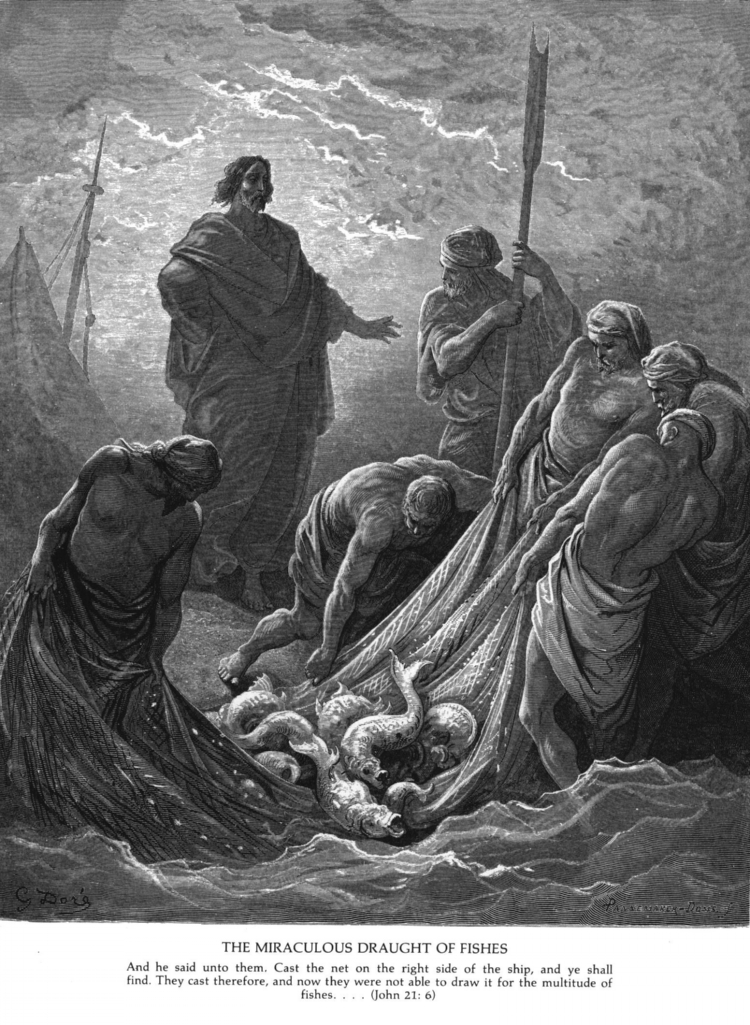
We might, like Peter, have to cast the net in a slightly different place. (John 21:6) But maybe not – maybe we just need to work harder, make a few changes, try again.What we shouldn’t do is to stop just because we see no results and move on to something else.

Fr Chevrot tells us to take the Church as our model. She is always in the process of beginning again. Her goods are confiscated, Her buildings are closed, She rebuilds others. She is always busy building temples, schools, chartable homes (often, I might add, for an ungrateful world who rebuffs Her) If Her institutions, Her works, which share in the evolution of societies have become obsolete, unworkable, She does not stick there; She creates new ones, better adapted to the difficulties of the day. The Church, which is promised eternity ad whose dogma never varies, never believes, in the work of Her apostolate, that She has created an absolutely binding precedent. She is always perfecting Her means of conquest with her own art of blending, in their exact proportions, the traditions to be maintains and the progress which will improve those traditions. Like Her first Head, She is always starting again to throw out the news, because like Him, She believes in the word of Jesus.

Duc in Altum! Cast out into the deep! Cast out your nets for suitable Catholics to join our band of Legionaries. Cast out your nets for Catholics who could be better Catholics and non-Catholics who might be interested in our faith. Don’t just be contented sailing in the shallow waters of our comfort zones. Cast out into the deep

This does involve hard work – the disciples had to row out at the Master’s word. But do it none the less.

Our nets too must be cleaned and ready for the catch. Our praesidium must always be strictly loyal to the Legion system; otherwise our catch will be defective. Work as a praesidium, pulling on the oars of the same boat. Don’t get tempted to just rely on our individual contact work as sufficient to fulfil our Legionary duty. Watch out for each other, call each other to help us in our work, just as the disciples did when their catch was too big to handle. Look after our auxiliary members and follow up on our contacts. Be loyal to each other, to the Praesidium and to Curia. It is through these that we show our loyalty to our Queen and to our God. Take care of the little things too – the altar, the timing, our notebooks – for "he that is faithful in that which is least, is faithful also in that which is greater" (Luke 16:10)

Make sure our work is heroic: heroic in the little things and heroic in the big. Draw others by your example. That’s what the senior Legionaries taught me in my first year. They were a really heroic bunch. Let’s make sure we do not relax in our efforts.

Canon Ripley also tells us that

“Difficulties and monotony give scope for the faith and effort of an enduring siege. [The Handbook] speaks of inexhaustible patience, golden tenacity and the unremitting search for those that have strayed. It is in the ordinary humdrum, unspectacular, wearisome, monotonous work that the essential qualities of the good Legionaries are best displayed. The Handbook says what those are: First unwavering faith; second, unrelaxed effort; third, unquenchable love; fourth, steady discipline; fifth, absolute and obstinate refusal to lose heart; sixth, constancy at all times; seventh, humility in success”

Finally, thank you for letting me serve you and for making my job so much easier than is should have been. I’ve received more than I could give back.

Let’s obey our new officers pray for them that the Holy Spirit will be their wisdom and their strength and that they too will grow and gain immensely from their office.

And may our courageous and heroic Queen guide and inspire us and all those who will join us in our battle to serve her faithfully and with ever greater devotion.

Amen

http://catholic-resources.org/Dore/John21.jpg

The Doré Bible Illustrations

Wednesday, October 1, 2008

More poems from San Juan de la Cruz

Of the communion of the three Persons

Out of the love immense and bright
That from the two had thus begun,
Words of ineffable delight
The Father spoke unto the Son:

Words of so infinite a rapture
Their drift by none could be explained:
Only the Son their sense could capture
That only to Himself pertained.

What of them we can sense the clearest
Was in this manner said and thought:
Out of Your company, my Dearest,
I can be satisfied by nought.

But if aught please me, I as duly
In You, Yourself, the cause construe.
The one who satisfies Me truly
Is him who most resembles You.

He who in naught resembles You
Shall find of Me no trace or sign,
Life of My Life! for only through
Your own can I rejoice in Mine.

You are the brilliance of My light
My wisdom and My power divine,
The figure of My substance bright
In whom I am well pleased to shine!

The man who loves You, O my Son,
To him Myself I will belong.
The love that in Yourself I won
I'll plant in him and root it stron,
Because he loved the very one
I loved so deeply and so long.


Suma de la perfeccion

Olvido de lo criado,
Memoria del Criador,
Atención a lo interior
Y estarse amando al Amado


Translation: Summary of perfection

Ignoring the created and inferior;
Remembering above all things the Creator;
Attention to the life that is interior;
For the Beloved love that's always greater.

Memorial of St. Therese of the Child Jesus


God, Our Father,

You promised Your Kingdom

to the little ones

and the humble of heart

Give us the grace

to walk confidently in the way

of St. Thérèse of the Child Jesus,

so that helped by her prayers,

we may see Your glory

and share in Your Kingdom. 


Papa John Paul II - The Impossible Dream