
An amazing lesson on faith and prayer. A rescue of epic proportions on The Feast of Our Lady of Fatima. De profundis clamavi ad te domine.


I heard it once too often.
You know how it goes. Some older Catholic, or ex-Catholic, tells you, “When I was growing up ...” — in the 1930s or ’40s or ’50s, maybe; or, perhaps, until Vatican II in the 1960s — “... when I was growing up, the Catholic Church said that only Catholics go to heaven.”
Balderdash.
Sometimes, it is said in all innocence. Sometimes, it is said accusingly. Sometimes, it is said with a virtual wink-of-the-eye, “knowingly,” as if to imply, You can believe that little white lie that the Church’s teachings don’t change. But I know better.
Malarkey.
Yes, I heard it once too often. So, here is a small compendium of Catholic teaching concerning the salvation of Non-Catholics. All of these documents were published before 1950. I present them here from oldest to newest, with a very brief extract from each. The links here go to pages that present the relevant passages of the documents. Those pages include links, when applicable, to the full documents elsewhere.
Fidelity to man requires fidelity to the truth, which alone is the guarantee of freedom (cf. Jn 8:32) and of the possibility of integral human development. For this reason the Church searches for truth, proclaims it tirelessly and recognizes it wherever it is manifested. This mission of truth is something that the Church can never renounce. Her social doctrine is a particular dimension of this proclamation: it is a service to the truth which sets us free. Open to the truth, from whichever branch of knowledge it comes, the Church's social doctrine receives it, assembles into a unity the fragments in which it is often found, and mediates it within the constantly changing life-patterns of the society of peoples and nations.
ENCYCLICAL LETTER
CARITAS IN VERITATE
OF THE SUPREME PONTIFF
BENEDICT XVI
TO THE BISHOPS
PRIESTS AND DEACONS
MEN AND WOMEN RELIGIOUS
THE LAY FAITHFUL
AND ALL PEOPLE OF GOOD WILL
ON INTEGRAL HUMAN DEVELOPMENT
IN CHARITY AND TRUTH
INTRODUCTION
1. Charity in truth, to which Jesus Christ bore witness by his earthly life and especially by his death and resurrection, is the principal driving force behind the authentic development of every person and of all humanity. Love — caritas — is an extraordinary force which leads people to opt for courageous and generous engagement in the field of justice and peace. It is a force that has its origin in God, Eternal Love and Absolute Truth. Each person finds his good by adherence to God's plan for him, in order to realize it fully: in this plan, he finds his truth, and through adherence to this truth he becomes free (cf. Jn 8:22). To defend the truth, to articulate it with humility and conviction, and to bear witness to it in life are therefore exacting and indispensable forms of charity.
(SDG)
SDG here with some thoughts on conscience and authority sparked by the combox from my last post.
Every man is bound absolutely to follow his own conscience. Hopefully, if and when a man finds that his judgments of conscience are contradicted by competent authority, he will take that fact into account in informing and revising his judgments of conscience.
But this doesn't mean blindly following competent authority. Sometimes, competent authority is wrong, and good men can honestly conclude that competent authority is wrong — sometimes when it is, sometimes when it isn't.
So there is still the possibility of contradiction. What happens then is … tricky.
If a man's conscience tells him that something is morally licit, and competent authority tells him otherwise, he will often be well advised to refrain from the activity in question in deference to competent authority.
If, on the other hand, a man's conscience tells him that something is morally obligatory — or morally illicit — and competent authority tells him the opposite, he must not act against his conscience in deference to authority.
If he is in sufficient doubt as to the rightness of his own judgment, and is swayed by the weight of authority, then he may arrive at a new judgment of conscience, putting his faith in authority to guide him. Assuming he is honest in this process, the responsibility for his actions now lies to a significant degree with that authority. If authority has led him astray, there are millstones for such things. If it has led him aright, there are rewards.
Conversely, if he remains confident enough of his own judgments as to reject the guidance of authority, then he himself incurs a new burden of responsibility for his actions. In that case, he had better hope and pray that he is right. Just as following authority can mitigate one's responsibility, flouting authority can aggravate it. That doesn't mean you can never, or should never, do it. It does mean you take your head in your hands.
If one is instructed by one's bishop not to present oneself for communion, there is an obligation to honor that instruction, even if one is privately convinced that the bishop's instruction is unjustified. If the bishop is right, he has saved a sheep from (hopefully unwitting) sacrilege. If he's wrong, a soul has suffered unecessarily, but with merit before God for sumbitting humbly to authority and meekly accepting unjust punishment.
However, even in such a case I don't think the obligation is necessarily absolute. Take the case of a couple — a pair of converts, let's say — whose marriage is not recognized by the Church because of a previous union for which the tribunal could not find evidence of nullity. And let's say the couple has appealed to Rome, attempted every recourse, all to no avail.
And now let's say that the couple knows, with great moral certitude, that even though they weren't able to prove it to the tribunal, the previous marriage was not valid, and so their current marriage is valid. In such a case, it seems to me, they are not morally obliged either to refrain from conjugal union or to refrain from receiving communion.
If they can do so without scandal — if, say, they attend a parish where the circumstances of their marriage are not known and no one has reason to suspect that their marriage isn't recognized by the Church — then I think it is possible for them to continue to live together as man and wife and to receive communion with a clear conscience.
Now, if the tribunal was right and the couple are wrong, their moral culpability is all the greater. When you rely on the internal forum, you accept a greater weight of judgment, just as you do when you presume to instruct or lead another.
Conversely, if a tribunal judges wrongly, and gives a couple a clean bill of marital health when in fact there is no marriage because of an existing impediment, if the couple acts in good faith in following the tribunal, the moral responsibility is the tribunal's, not the couple's. (It's also worth noting that there is an obligation to try to work things out through the external forum, not just settle for the internal forum from the get-go. One might possibly choose, with fear and trembling, to disregard the wrongful verdict of a marriage tribunal, but this doesn't mean that you don't have to bother petitioning for a decree of nullity in the first place.)
(SDG)
SDG here with some follow-up thoughts on conscience, sparked by comments in the last combox. A reader writes:
The proper formation of one's conscience is at the heart of all the hypotheticals. Personally, I don't know if I could count on my own conscience without lining it up with the Church's teachings.
Yes indeed, proper formation of conscience is crucially important. However, the authority of a poorly formed conscience is just as absolute as that of a well-formed conscience. However well or poorly one's conscience may be formed, one is always absolutely bound to follow one's conscience, that is, one's last best judgment of what one ought to do. If a man has a dreadfully formed conscience, he may be led to do dreadful things. But to go against one's one's last best judgment of what one ought to do, to do what one believes is wrong, is the essence, the very form, of sin.
Note what this doesn't mean: It doesn't mean privileging your own sense of a particular issue over the voice of authority, whether the word of God, the Magisterium, or lesser authorities like parents, government leaders or social consensus. It does mean that when you have listened to all relevant authorities and arguments, taking everything into account, whatever you believe in the end you ought to do is what you must do.
If a person holds a moral opinion contrary to Magisterial teaching, it would certainly be well for him if his conscience, however flawed, were at least well-formed enough for him to conclude, "Even though my own sense of the issue is very far from what the Church says, and I really can't see the reasoning behind it, at the same time I do believe that the Holy Spirit guides the Church, and that tells me that I ought to listen to the Church even though I don't understand." In that case, his conscience — his last best judgment of what he ought to do — tells him to listen to the Church, and that is what he ought to do.
However, suppose his conscience is so poorly formed that he thinks, "I'd really like to be able to trust the Church here, but I just can't. I think the Church is wrong, and I can't do what the Church wants me to without violating my conscience." That is certainly a disastrous conclusion — but, having reached that conclusion, as long as he remains in that faulty opinion, for him to follow the Church anyway (say, out of timidity, social pressure or for some other reason) would be to go against his conscience, and thus to formal sin. Given his faulty reasoning, he must obey the voice of his conscience, even though this means disobeying the Church and committing material sin.
Of course it would be better for him to correct his faulty reasoning at least enough to conclude that it probably makes more sense to trust the Church than his own sense of the issue. Better still, he should correct his conscience enough to understand and assent to the Church's teaching on the basis of its own intelligibility. Obviously, a better informed conscience will lead you more reliably and safely than a poorly formed one. Doing what you believe is right is no shield against the bad consequences of sinful and destructive actions. But doing what you believe is wrong, pitting the will itself against the good, puts one as far from beatitude as it is possible to be.
Thus, when the reader writes, "I don't know if I could count on my own conscience without lining it up with the Church's teachings," it sounds as if the reader's conscience tells her that the Church's teachings must inform her last best judgment of what she ought to do — and if she were to find herself at odds with the Church, she would conclude that she hadn't yet reached a last best judgment. That's as it should be.
In other words, if one's thinking is, "My own sense of the issue is to do X, but the Church tells me to do Y, and in the end I trust the Church more than my own sense of the issue, so I think I should do Y," then one is not trusting the Church instead of one's conscience. Rather, one's conscience tells one to do Y, not X, in keeping with the Church's teaching.
Lots of people don't understand this point.
(SDG)
In the combox for part 2, a reader writes:
But where might the concept of natural law come in — that is, the idea that certain moral laws are written on all people's hearts, such that they cannot authentically claim that they didn't recognize the wrongness of a certain action?
It would seem to me that such persons would have to actively "bury" the natural law in order to not recognize the wrongness of such actions — and it is that choice to "bury" the law that is sinful and extends sin to the actions that follow.
Natural law is assumed throughout my comments on conscience and authority. If there were no natural law, we would have no basis for arriving at judgments of right and wrong — we could only have blind intuitions, authoritative declarations or some combination of the two. Morality would seem totally random to us; we could have no insight into why something was right or wrong.
The possibility of "burying" or suppressing innate knowledge of right and wrong is of course always an ever-present factor to be contended with. To the extent that one is culpable for the false conclusions one arrives at, one has deliberately avoided reaching, or has at least sabotaged, one's "last best" judgment about the right thing to do.
To that extent, one is culpable for misforming one's conscience and therefore to that extent for the false judgments one arrives at — what is called "vincible" ignorance — and the sinful acts one commits in that state.
However, the disfiguring effects of original sin upon the faculties — what Catholic theology calls concupiscence — are also an important factor impeding us from coming to a knowledge of the truth, even the truth written on our hearts. Because of this, it can be difficult or even impossible for us to ascertain the extent to which our own acts of suppression, as opposed to the innate brokenness of our fallen condition, are responsible for our flawed knowledge of moral truth.
So, while it's true that the moral law is written on our hearts so that we have knowledge of the truth, it's also true that our intellects have been darkened by original sin, and this darkened condition is part of the concupiscent weakness that, even after original sin is washed away by baptism and we are reborn in Christ, makes it hard for us to attain, understand and retain spiritual truth in the fulness of its beauty and integrity.
This is why we need proper formation, as well as the illumination of regeneration, to help compensate for, correct and transcend the limitations of our broken ability to interpret correctly the truths written on our hearts. Ignorance of this sort, for which one is not culpable, is called "invicible" ignorance.
Thus, for example, we can't necessarily say with confidence that a Protestant raised in a culture where acceptance of contraception is unanimous, or a Muslim raised with acceptance of polygamy, etc., is personally culpable for suppressing his conscience on these points — i.e., that his ignorance is vincible rather than invincible. Unanimous cultural consensus carries significant moral authority, and in the absence of adequate formation the truths written on our hearts may not come across with sufficient clarity to the darkened intellect to empower the individual to challenge his culture.
Or again they may, by God's grace, for a particular person. But it's for God alone to judge that in a particular case a person is necessarily culpable for burying the witness of his conscience. Even when it comes to more disturbing practices or institutions (female genital mutilation or male castration, for instance, or even human sacrifice), ascertaining the moral culpability of individuals is not for use to judge.
I'm not denying that individuals in such cultures, or some individuals, may know somewhere deep down that these things are wrong, and may be culpable for suppressing such knowledge of the truth as they may find written on their hearts. I'm saying that concupiscence complicates things, and only God can can ascertain the vincibility or invicibility of particular errors, the culpability or inculpability of a particular person's failure to discern truths written on our hearts.
I remember Fr. Marin's allocutio two or three weeks ago. He stressed on the importance of confession. We cannot forgive ourselves with some hocus-pocus introspection. Nor can we ask others to forgive us. The only way we know for sure that our sins have been forgiven is by receiving it from Christ himself, and that is what we receive when we go for confession.
From Fr. Z:
Jesus Christ, God and Savior, gave us the Sacrament of Penance, of Reconciliation.
This is the ordinary means by which He desires us to seek forgiveness for our actual, post-baptismal sins.
There is no sin that any limited little mortal can commit which is so bad that God cannot forgive it.
Christ gave His own power to forgive sins to the Church He established, the Catholic Church.
Priests exercise this ministry in the Church, acting by virtue of their ordination, as "another Christ".
When you confess your sins to a priest and he gives you absolution, you sins are taken away… not merely covered over or set aside. They are no more. You may remember them in sorrow, but they no longer harm your relationship with God.
Mortal sins break your saving friendship with God. Mortal sin places you at risk of eternal separation from God and the happiness of heaven… forever.
Confession and absolution repairs that rupture and returns you to a state of friendship with God.
Awareness of mortal sin should drive you to a confessional.
In our weakness we will sometimes put off going to confession. Perhaps fear or embarrassment keeps us away. Time slips by. Days become weeks become months become years.
Then you die and go to your judgment.So … maybe the priest is not friendly or the confession schedule is a little narrow…. so what? A better confessor is some distance away… so? It is a little hard… not convenient… too much to do…. And?
What is a moment of embarrassment, what is an interruption of your oh-so-important routine compared to the eternity of heaven or of hell?
You do not know the moment when your reckoning will come, friends.
Have you fallen into the trap, willingly or innocently, of going to "general absolution" without making a confession of your sins in the proper way?The Sacrament of Penance heals your soul, strengthens you against sin, and – simply on the basic level of peace of mind – works wonders.
I will never forget one somewhat slow afternoon in a confessional… just a bit bored… I heard someone get in and slid open the window. "Bless me Father, I have sinned. It has been sixty years since my last confession…."
When we were finished he wept and said "I’m free."
Our question:When was the last time you went to confession?
THE HAIL MARY - in Arabic
ASSALAMU 'ALAYKI YA MARYAM YA MUMTALIA NI'MATAN ARRABU MA'KI MUBARAKATON ANTI BAYNA NISSA WA MUBARAKON SAMRATU BATNIKI SAYIDINA YASU' L MASIH YA KIDDISA MARYAM YA WALIDATAL LAH SALLI LIAJLINA NAHNUL KHATAA AL ANA WA FI SA' ATI MAWTINA. AMIN.
PROFESSION OF FAITH
8. We believe in one only God, Father, Son and Holy Spirit, creator of things visible such as this world in which our transient life passes, of things invisible such as the pure spirits which are also called angels,(3) and creator in each man of his spiritual and immortal soul.
9. We believe that this only God is absolutely one in His infinitely holy essence as also in all His perfections, in His omnipotence, His infinite knowledge, His providence, His will and His love. He is He who is, as He revealed to Moses;(4) and He is love, as the apostle John teaches us:(5) so that these two names, being and love, express ineffably the same divine reality of Him who has wished to make Himself known to us, and who, "dwelling in light inaccessible,"(6) is in Himself above every name, above every thing and above every created intellect. God alone can give us right and full knowledge of this reality by revealing Himself as Father, Son and Holy Spirit, in whose eternal life we are by grace called to share, here below in the obscurity of faith and after death in eternal light. The mutual bonds which eternally constitute the Three Persons, who are each one and the same divine being, are the blessed inmost life of God thrice holy, infinitely beyond all that we can conceive in human measure.(7) We give thanks, however, to the divine goodness that very many believers can testify with us before men to the unity of God, even though they know not the mystery of the most holy Trinity.
The Father
10. We believe then in the Father who eternally begets the Son; in the Son, the Word of God, who is eternally begotten; in the Holy Spirit, the uncreated Person who proceeds from the Father and the Son as their eternal love. Thus in the Three Divine Persons, coaeternae sibi et coaequales,(8) the life and beatitude of God perfectly one superabound and are consummated in the supreme excellence and glory proper to uncreated being, and always "there should be venerated unity in the Trinity and Trinity in the unity."(9)
The Son
11. We believe in our Lord Jesus Christ, who is the Son of God. He is the Eternal Word, born of the Father before time began, and one in substance with the Father, homoousios to Patri,(10) and through Him all things were made. He was incarnate of the Virgin Mary by the power of the Holy Spirit, and was made man: equal therefore to the Father according to His divinity, and inferior to the Father according to His humanity;(11) and Himself one, not by some impossible confusion of His natures, but by the unity of His person.(12)
12. He dwelt among us, full of grace and truth. He proclaimed and established the Kingdom of God and made us know in Himself the Father. He gave us His new commandment to love one another as He loved us. He taught us the way of the beatitudes of the Gospel: poverty in spirit, meekness, suffering borne with patience, thirst after justice, mercy, purity of heart, will for peace, persecution suffered for justice sake. Under Pontius Pilate He suffered—the Lamb of God bearing on Himself the sins of the world, and He died for us on the cross, saving us by His redeeming blood. He was buried, and, of His own power, rose on the third day, raising us by His resurrection to that sharing in the divine life which is the life of grace. He ascended to heaven, and He will come again, this time in glory, to judge the living and the dead: each according to his merits—those who have responded to the love and piety of God going to eternal life, those who have refused them to the end going to the fire that is not extinguished.
And His Kingdom will have no end.
The Holy Spirit
13. We believe in the Holy Spirit, who is Lord and Giver of life, who is adored and glorified together with the Father and the Son. He spoke to us by the prophets; He was sent by Christ after His resurrection and His ascension to the Father; He illuminates, vivifies, protects and guides the Church; He purifies the Church's members if they do not shun His grace. His action, which penetrates to the inmost of the soul, enables man to respond to the call of Jesus: Be perfect as your Heavenly Father is perfect (Mt. 5:48).
14. We believe that Mary is the Mother, who remained ever a Virgin, of the Incarnate Word, our God and Savior Jesus Christ,(13) and that by reason of this singular election, she was, in consideration of the merits of her Son, redeemed in a more eminent manner,(14) preserved from all stain of original sin(15) and filled with the gift of grace more than all other creatures.(16)
15. Joined by a close and indissoluble bond to the Mysteries of the Incarnation and Redemption,(17) the Blessed Virgin, the Immaculate, was at the end of her earthly life raised body and soul to heavenly glory(18) and likened to her risen Son in anticipation of the future lot of all the just; and we believe that the Blessed Mother of God, the New Eve, Mother of the Church,(19) continues in heaven her maternal role with regard to Christ's members, cooperating with the birth and growth of divine life in the souls of the redeemed.(20)
Original Offense
16. We believe that in Adam all have sinned, which means that the original offense committed by him caused human nature, common to all men, to fall to a state in which it bears the consequences of that offense, and which is not the state in which it was at first in our first parents—established as they were in holiness and justice, and in which man knew neither evil nor death. It is human nature so fallen, stripped of the grace that clothed it, injured in its own natural powers and subjected to the dominion of death, that is transmitted to all men, and it is in this sense that every man is born in sin. We therefore hold, with the Council of Trent, that original sin is transmitted with human nature, "not by imitation, but by propagation" and that it is thus "proper to everyone."(21)
Reborn of the Holy Spirit
17. We believe that o ur Lord Jesus Christ, by the sacrifice of the cross redeemed us from original sin and all the personal sins committed by each one of us, so that, in accordance with the word of the apostle, "where sin abounded, grace did more abound."(22)
Baptism
18. We believe in one Baptism instituted by our Lord Jesus Christ for the remission of sins. Baptism should be administered even to little children who have not yet been able to be guilty of any personal sin, in order that, though born deprived of supernatural grace, they may be reborn "of water and the Holy Spirit" to the divine life in Christ Jesus.(23)
The Church
19. We believe in one, holy, catholic, and apostolic Church, built by Jesus Christ on that rock which is Peter. She is the Mystical Body of Christ; at the same time a visible society instituted with hierarchical organs, and a spiritual community; the Church on earth, the pilgrim People of God here below, and the Church filled with heavenly blessings; the germ and the first fruits of the Kingdom of God, through which the work and the sufferings of Redemption are continued throughout human history, and which looks for its perfect accomplishment beyond time in glory.(24) In the course of time, the Lord Jesus forms His Church by means of the sacraments emanating from His plenitude.(25) By these she makes her members participants in the Mystery of the Death and Resurrection of Christ, in the grace of the Holy Spirit who gives her life and movement.(26) She is therefore holy, though she has sinners in her bosom, because she herself has no other life but that of grace: it is by living by her life that her members are sanctified; it is by removing themselves from her life that they fall into sins and disorders that prevent the radiation of her sanctity. This is why she suffers and does penance for these offenses, of which she has the power to heal her children through the blood of Christ and the gift of the Holy Spirit.
The Word
20. Heiress of the divine promises and daughter of Abraham according to the Spirit, through that Israel whose scriptures she lovingly guards, and whose patriarchs and prophets she venerates; founded upon the apostles and handing on from century to century their ever-living word and their powers as pastors in the successor of Peter and the bishops in communion with him; perpetually assisted by the Holy Spirit, she has the charge of guarding, teaching, explaining and spreading the Truth which God revealed in a then veiled manner by the prophets, and fully by the Lord Jesus. We believe all that is contained in the word of God written or handed down, and that the Church proposes for belief as divinely revealed, whether by a solemn judgment or by the ordinary and universal magisterium.(27) We believe in the infallibility enjoyed by the successor of Peter when he teaches ex cathedra as pastor and teacher of all the faithful,(28) and which is assured also to the episcopal body when it exercises with him the supreme magisterium.(29)
21. We believe that the Church founded by Jesus Christ and for which He prayed is indefectibly one in faith, worship and the bond of hierarchical communion. In the bosom of this Church, the rich variety of liturgical rites and the legitimate diversity of theological and spiritual heritages and special disciplines, far from injuring her unity, make it more manifest.(30)
One Shepherd
22. Recognizing also the existence, outside the organism of the Church of Christ, of numerous elements of truth and sanctification which belong to her as her own and tend to Catholic unity,(31) and believing in the action of the Holy Spirit who stirs up in the heart of the disciples of Christ love of this unity,(32) we entertain the hope that the Christians who are not yet in the full communion of the one only Church will one day be reunited in one flock with one only shepherd.
23. We believe that the Church is necessary for salvation, because Christ, who is the sole mediator and way of salvation, renders Himself present for us in His body which is the Church.(33) But the divine design of salvation embraces all men; and those who without fault on their part do not know the Gospel of Christ and His Church, but seek God sincerely, and under the influence of grace endeavor to do His will as recognized through the promptings of their conscience, they, in a number known only to God, can obtain salvation.(34)
Sacrifice of Calvary
24. We believe that the Mass, celebrated by the priest representing the person of Christ by virtue of the power received through the Sacrament of Orders, and offered by him in the name of Christ and the members of His Mystical Body, is the sacrifice of Calvary rendered sacramentally present on our altars. We believe that as the bread and wine consecrated by the Lord at the Last Supper were changed into His body and His blood which were to be offered for us on the cross, likewise the bread and wine consecrated by the priest are changed into the body and blood of Christ enthroned gloriously in heaven, and we believe that the mysterious presence of the Lord, under what continues to appear to our senses as before, is a true, real and substantial presence.(35)
Transubstantiation
25. Christ cannot be thus present in this sacrament except by the change into His body of the reality itself of the bread and the change into His blood of the reality itself of the wine, leaving unchanged only the properties of the bread and wine which our senses perceive. This mysterious change is very appropriately called by the Church transubstantiation. Every theological explanation which seeks some understanding of this mystery must, in order to be in accord with Catholic faith, maintain that in the reality itself, independently of our mind, the bread and wine have ceased to exist after the Consecration, so that it is the adorable body and blood of the Lord Jesus that from then on are really before us under the sacramental species of bread and wine,(36) as the Lord willed it, in order to give Himself to us as food and to associate us with the unity of His Mystical Body.(37)
26. The unique and indivisible existence of the Lord glorious in heaven is not multiplied, but is rendered present by the sacrament in the many places on earth where Mass is celebrated. And this existence remains present, after the sacrifice, in the Blessed Sacrament which is, in the tabernacle, the living heart of each of our churches. And it is our very sweet duty to honor and adore in the blessed Host which our eyes see, the Incarnate Word whom they cannot see, and who, without leaving heaven, is made present before us.
Temporal Concern
27. We confess that the Kingdom of God begun here below in the Church of Christ is not of this world whose form is passing, and that its proper growth cannot be confounded with the progress of civilization, of science or of human technology, but that it consists in an ever more profound knowledge of the unfathomable riches of Christ, an ever stronger hope in eternal blessings, an ever more ardent response to the love of God, and an ever more generous bestowal of grace and holiness among men. But it is this same love which induces the Church to concern herself constantly about the true temporal welfare of men. Without ceasing to recall to her children that they have not here a lasting dwelling, she also urges them to contribute, each according to his vocation and his means, to the welfare of their earthly city, to promote justice, peace and brotherhood among men, to give their aid freely to their brothers, especially to the poorest and most unfortunate. The deep solicitude of the Church, the Spouse of Christ, for the needs of men, for their joys and hopes, their griefs and efforts, is therefore nothing other than her great desire to be present to them, in order to illuminate them with the light of Christ and to gather them all in Him, their only Savior. This solicitude can never mean that the Church conform herself to the things of this world, or that she lessen the ardor of her expectation of her Lord and of the eternal Kingdom.
28. We believe in the life eternal. We believe that the souls of all those who die in the grace of Christ whether they must still be purified in purgatory, or whether from the moment they leave their bodies Jesus takes them to paradise as He did for the Good Thief are the People of God in the eternity beyond death, which will be finally conquered on the day of the Resurrection when these souls will be reunited with their bodies.
Prospect of Resurrection
29. We believe that the multitude of those gathered around Jesus and Mary in paradise forms the Church of Heaven where in eternal beatitude they see God as He is,(38) and where they also, in different degrees, are associated with the holy angels in the divine rule exercised by Christ in glory, interceding for us and helping our weakness by their brotherly care.(39)
30. We believe in the communion of all the faithful of Christ, those who are pilgrims on earth, the dead who are attaining their purification, and the blessed in heaven, all together forming one Church; and we believe that in this communion the merciful love of God and His saints is ever listening to our prayers, as Jesus told us: Ask and you will receive.(40) Thus it is with faith and in hope that we look forward to the resurrection of the dead, and the life of the world to come.
Blessed be God Thrice Holy. Amen.
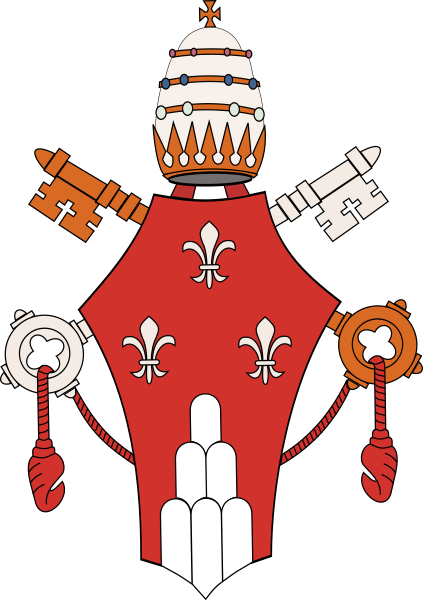
PAUL VI


