Support the Holy Father and pray with him!
"Young people in particular, I appeal to you: bear witness to your faith through the digital world!"
-Pope Benedict XVI

-Pope Benedict XVI
Sunday, November 17, 2013

Thursday, August 23, 2012
Faith and Reason Series: The Bible & Evolution
'Religions do make claims about the universe - the same kinds of claims that scientists make, except they're usually false.'
'Evolution is God's redundancy notice, his pink slip.'
Is Christianity incompatible with the theory of Evolution? Is there no need, no place for God, now that science can explain our origins?
Pope John Paul II once said that
'…evolution [is] more than a hypothesis…. The convergence in the results of these independent studies—which wasneither planned nor sought—constitutes in itself a significant argument in favor of the theory.'
Was this a change of position and an accommodation to facts of science that no longer could be ignored?
Find out more about Christianity and the theory of evolution, and also about how Catholics understand the origins, authorship and purpose of Scripture at this latest installment of the "Faith and Reason" series.
When? Tue, 28 Aug, 7-9pm
Where? Central Library Theatrette 2
Speakers:
Dr Patrick Gilligan, PhD Molecular and Cell Biology
Fr Jose Lopez, M.A. English and English Literature, PhD Philosophy
RSVP: tinyurl.com/BibleandEvolution

'Evolution is God's redundancy notice, his pink slip.'
- Richard Dawkins
Is Christianity incompatible with the theory of Evolution? Is there no need, no place for God, now that science can explain our origins?
Pope John Paul II once said that
'…evolution [is] more than a hypothesis…. The convergence in the results of these independent studies—which wasneither planned nor sought—constitutes in itself a significant argument in favor of the theory.'
Was this a change of position and an accommodation to facts of science that no longer could be ignored?
Find out more about Christianity and the theory of evolution, and also about how Catholics understand the origins, authorship and purpose of Scripture at this latest installment of the "Faith and Reason" series.
When? Tue, 28 Aug, 7-9pm
Where? Central Library Theatrette 2
Speakers:
Dr Patrick Gilligan, PhD Molecular and Cell Biology
Fr Jose Lopez, M.A. English and English Literature, PhD Philosophy
RSVP: tinyurl.com/BibleandEvolution
Saturday, August 11, 2012
Come and eat!
It was really fun preparing the meals and hosting our friends who helped us man the Legion booth at Matriculation Fair. :)


Friday, March 2, 2012
Talk: Fides et Ratio (Faith and Reason)
On the economy - "economic policy cannot be guided by a profit-driven mentality alone"...
On the environment - "If you want to cultivate Peace, protect Creation"...
On population control - "population is proving to be an asset, not a factor that contributes to poverty"...
- Pope Benedict XVI
Have you wondered...
Why should the Church be 'meddling' with secular issues? Why hasn't she learn something after Galileo Galilei's incident? Can the Church be reasonable in these secular issues (i.e Can Faith and Reason be compatible)?
If you answered "Yes"...
You are invited to the first of a series of talks: "Fides et Ratio" (Faith and Reason)
(We sincerely apologize that this event is opened for NUS STUDENTS AND STAFF ONLY)
When??? Thursday, 15 March, 7-9pm
Where??? Central Library Theatrette 1 How??? RSVP Here!

Speaker 1: Dr. Mark Nowacki
Dr. Nowacki is a is an Assistant Professor of Philosophy at Singapore Management University. His research interests includes philosophy of science, philosophy of religion and metaphysics. In this talk, he will explore some of the reasons as to why Faith and Reason - the basis on which the Church engages worldly issues, are not only inseparable but should also be exercise together.
Speaker 2: Dr. Jose Chan Martinez
Dr. Martinez is a research fellow in the Department of Electrical and Computer Engineering. Currently, he has been a keen interest in graphene and its properties. With his training as a physicist, Dr. Martinez would share about Galileo Galilei's findings and what was in conflict with the Church.
Please contact us for more information: nuslegionofmary@gmail.com
Do invite your friends too!! http://www.facebook.com/events/139393126183750/
Wednesday, January 18, 2012
Just a Random Thought of my Mind
Have you ever asked yourself why religion is so important?
Have you ever asked why all civilizations in this world sustain their own so called religion?
In fact religions motored most if not all early developments. Ask yourself why some important milestones of civilizations occurred when religions are reconsidered or introduced. I am not going to go deeper but it is easily observed that architecture, arts and philosophy are the fruits of religion.
Then I am to invite your imagination. A society of great number of peoples existed in a random area. You can say that the civilization is "barbaric" (donot raise an image of cannibals sort of animal but rather uncivilized people). What sort of Deus ex machina can unearth order out of them?
Well, you can say politics, laws, philosophies, ethics, cultures ,etc. But as far as things I have learned, religion is the best mean. I am not saying that it works to all of them. But consider, fear and hope are the best weapon of controlling people.
Does that answer why religions are present in every culture?
I will not say so, but rather religion is more towards a necessity of a society to proceed to be counted among great civilizations.
That once drifted me from my faith. First, religion can be forged by some immensely smart guys. Secondly, what worked for people in the past -or rather, early stage of a society- may not what works best for our age. Third, there are so many religions using miracles as their tools, why should the Israelite's be so special?
I will not share my answer for the first and the second one for the time being, this will be too lengthy a passage. But I must say that I found most of these things myself by a simple method: go somewhere quiet, sit or lie down comfortably and comtemplate about those stuffs.
Prayer can be a mean to do that (I should not write this thing, but hey, we cannot simply encourage people who has already their faith shaken to pray. Faith ultimately is a gift).
Then it brings me to the third point.
If I am working on a presumption that Jesus is only one of great founders of religion ,why do I find Catholic so special?
The answer jumped into my mind in an astonishingly simple word. Perfection.
What is so perfect?
Think and observe, what kind of religion have a better story (I am not trying to humiliate other religion, please dont get me wrong on these)
Why does Christian becomes almost one third of world's population (which means that almost half of the world worship the same God YHWH)? Simply opus homini?
Who has simple yet complex, easy yet difficult, happy yet not so happy teachings, demanding yet not demanding teaching?
Who offers a highest value or forms of morality?
Then who has a very well rounded teaching based on examples.
What do I mean by well rounded?
Ok, universality is one of the things I admire about my God. He has a way to reach people.
Men are born interested in different areas. Some like arts, some do not attracted to arts at all. Likewise, some people prefer hard examples. Some appeal to miracles and mystical or supernatural stuff. Some like sophisticated stuffs and adore train of reasoning. Some found themselves interested in prediction or even intervention of the veiled future. Some are attracted to beauty of things (like literary stuff).
Where on earth can I find all those things? Nowhere else but the gospel. People in the past liked to see miracles, that's what they had. Our Lord divulged some of his foresight in the gospel. Then, the beauty of things (I must say that bible are beautiful as a literature). And when the society grows more mature, they prefer to use their logic. That was where all great philosophers emerged and there were the place of doctors of the church. Great church mystics, prophets and even our Lord's own experience provide the answer to those who dwell in mystical domain. After grew weary with complex stuff, pragmatic way of thinking arose. Some demand proofs.
They like to ask : where are the hard facts, where are the proofs?
I will say that God Himself, saints, and prophets is the answer.
That is how great God is. In the end, ultimately it is about a love to God, Jesus Himself, no matter from whence you approach Him. Eventually, all complex analysis and philosphies converges into one, communion with Himself.
God knew this. We were in his mind before everything else. He provides for all of us. He just want us to love Him, no matter how we discover our love. You cannot blame nor discourage people for being rational and critical, likewise you cannot depreciate simple-minded and pragmatics.
Questa veritamenti opus Dei
"That really is the work of God"
(Most of things here are not elaborated, I can say each statement may cost pages to reason, sorry for that)
Have you ever asked why all civilizations in this world sustain their own so called religion?
In fact religions motored most if not all early developments. Ask yourself why some important milestones of civilizations occurred when religions are reconsidered or introduced. I am not going to go deeper but it is easily observed that architecture, arts and philosophy are the fruits of religion.
Then I am to invite your imagination. A society of great number of peoples existed in a random area. You can say that the civilization is "barbaric" (donot raise an image of cannibals sort of animal but rather uncivilized people). What sort of Deus ex machina can unearth order out of them?
Well, you can say politics, laws, philosophies, ethics, cultures ,etc. But as far as things I have learned, religion is the best mean. I am not saying that it works to all of them. But consider, fear and hope are the best weapon of controlling people.
Does that answer why religions are present in every culture?
I will not say so, but rather religion is more towards a necessity of a society to proceed to be counted among great civilizations.
That once drifted me from my faith. First, religion can be forged by some immensely smart guys. Secondly, what worked for people in the past -or rather, early stage of a society- may not what works best for our age. Third, there are so many religions using miracles as their tools, why should the Israelite's be so special?
I will not share my answer for the first and the second one for the time being, this will be too lengthy a passage. But I must say that I found most of these things myself by a simple method: go somewhere quiet, sit or lie down comfortably and comtemplate about those stuffs.
Prayer can be a mean to do that (I should not write this thing, but hey, we cannot simply encourage people who has already their faith shaken to pray. Faith ultimately is a gift).
Then it brings me to the third point.
If I am working on a presumption that Jesus is only one of great founders of religion ,why do I find Catholic so special?
The answer jumped into my mind in an astonishingly simple word. Perfection.
What is so perfect?
Think and observe, what kind of religion have a better story (I am not trying to humiliate other religion, please dont get me wrong on these)
Why does Christian becomes almost one third of world's population (which means that almost half of the world worship the same God YHWH)? Simply opus homini?
Who has simple yet complex, easy yet difficult, happy yet not so happy teachings, demanding yet not demanding teaching?
Who offers a highest value or forms of morality?
Then who has a very well rounded teaching based on examples.
What do I mean by well rounded?
Ok, universality is one of the things I admire about my God. He has a way to reach people.
Men are born interested in different areas. Some like arts, some do not attracted to arts at all. Likewise, some people prefer hard examples. Some appeal to miracles and mystical or supernatural stuff. Some like sophisticated stuffs and adore train of reasoning. Some found themselves interested in prediction or even intervention of the veiled future. Some are attracted to beauty of things (like literary stuff).
Where on earth can I find all those things? Nowhere else but the gospel. People in the past liked to see miracles, that's what they had. Our Lord divulged some of his foresight in the gospel. Then, the beauty of things (I must say that bible are beautiful as a literature). And when the society grows more mature, they prefer to use their logic. That was where all great philosophers emerged and there were the place of doctors of the church. Great church mystics, prophets and even our Lord's own experience provide the answer to those who dwell in mystical domain. After grew weary with complex stuff, pragmatic way of thinking arose. Some demand proofs.
They like to ask : where are the hard facts, where are the proofs?
I will say that God Himself, saints, and prophets is the answer.
That is how great God is. In the end, ultimately it is about a love to God, Jesus Himself, no matter from whence you approach Him. Eventually, all complex analysis and philosphies converges into one, communion with Himself.
God knew this. We were in his mind before everything else. He provides for all of us. He just want us to love Him, no matter how we discover our love. You cannot blame nor discourage people for being rational and critical, likewise you cannot depreciate simple-minded and pragmatics.
Questa veritamenti opus Dei
"That really is the work of God"
(Most of things here are not elaborated, I can say each statement may cost pages to reason, sorry for that)
Sunday, November 27, 2011
We Long to See You
We long to see You so,
To see the newly born,
We long for Christmas morn,
The sense of time runs slow.
O come, O come, O come,
Our Saviour dear to be.
O come, O come, O come,
We have no King but Thee.
We long to see You so,
To see the angel's glory,
To hear their midnight story
And with the Shepherds go.
We long to see You so,
To print our kisses sweet,
Upon your little feet
While tears of love shall flow.
Here's the first of my Christmas songs this season. :)
Such a simple little hymn, but it's brimming with joyful impatience and tender love isn't it? The choir sang this at the 11am Mass at St Joseph's Church (BT) today. It was my first time hearing it.
During the past few weeks there was a bit of this ennui, the joyful feeling of Christmas hadn't yet caught on. I looked at the Orchard decorations rather cynically - oh great, they're up already - they'll look so old and tired by the time it's really Christmas.
But thank God, and thanks to a couple of meditations at Opus Dei, a homily by Fr Cary, a chat with Fr Joe Lopez, some prayers and resolutions, I'm able to start Advent in anticipation and hope.
A blessed Advent to you all! May hope reign in us, and may we be agents, stars, of hope for others too this lovely, magical season.
'Let us learn from her, the Woman of Advent, how to live our daily actions with a new spirit, with the feeling of profound expectation that only the coming of God can fulfil.' (Pope Benedict, 28 November, 2010).
To see the newly born,
We long for Christmas morn,
The sense of time runs slow.
O come, O come, O come,
Our Saviour dear to be.
O come, O come, O come,
We have no King but Thee.
We long to see You so,
To see the angel's glory,
To hear their midnight story
And with the Shepherds go.
We long to see You so,
To print our kisses sweet,
Upon your little feet
While tears of love shall flow.
Here's the first of my Christmas songs this season. :)
Such a simple little hymn, but it's brimming with joyful impatience and tender love isn't it? The choir sang this at the 11am Mass at St Joseph's Church (BT) today. It was my first time hearing it.
During the past few weeks there was a bit of this ennui, the joyful feeling of Christmas hadn't yet caught on. I looked at the Orchard decorations rather cynically - oh great, they're up already - they'll look so old and tired by the time it's really Christmas.
But thank God, and thanks to a couple of meditations at Opus Dei, a homily by Fr Cary, a chat with Fr Joe Lopez, some prayers and resolutions, I'm able to start Advent in anticipation and hope.
A blessed Advent to you all! May hope reign in us, and may we be agents, stars, of hope for others too this lovely, magical season.
'Let us learn from her, the Woman of Advent, how to live our daily actions with a new spirit, with the feeling of profound expectation that only the coming of God can fulfil.' (Pope Benedict, 28 November, 2010).
Thursday, November 24, 2011
Refreshed!!!
I've realized that this blog hasn't been updated for a looooonggg time, so let me share a simple story of our Legion meeting last Tuesday.
Two days ago I actually felt very tired of studying (it's exam period in NUS). 7pm is our meeting time and initially I thought I wouldn't have energy to smile a lot during meeting. Hahaha. It was just so tiring to read various human rights convention on that day for my module preparation.
However, it's amazing how Mother Mary works during meeting. She works through each member in a unique way. Honestly, we haven't put FRESH flowers on the altar for a looooonngggg time. Eugene brought flowers on Tuesday and it was two stalks of yellow chrystanthemum(?). So pretty!!! You can smell the fresh aroma of the flowers (and the leaves) even during rosary. This simple thing apparently has brought different atmosphere to the meeting.
Then, the meeting goes on. Every meeting is always unique. Different members share different stories of the apostolic work that they have done for the whole week. It's always interesting and we can learn a lot from each other's report.
So yeah...after the meeting on Tuesday, I felt SUPER-REFRESHED! Hehehe.
Thank you, Mother Mary!! :):)
See you all next Tuesday and thanks for the support during exams!! Yeay:):)
Two days ago I actually felt very tired of studying (it's exam period in NUS). 7pm is our meeting time and initially I thought I wouldn't have energy to smile a lot during meeting. Hahaha. It was just so tiring to read various human rights convention on that day for my module preparation.
However, it's amazing how Mother Mary works during meeting. She works through each member in a unique way. Honestly, we haven't put FRESH flowers on the altar for a looooonngggg time. Eugene brought flowers on Tuesday and it was two stalks of yellow chrystanthemum(?). So pretty!!! You can smell the fresh aroma of the flowers (and the leaves) even during rosary. This simple thing apparently has brought different atmosphere to the meeting.
Then, the meeting goes on. Every meeting is always unique. Different members share different stories of the apostolic work that they have done for the whole week. It's always interesting and we can learn a lot from each other's report.
So yeah...after the meeting on Tuesday, I felt SUPER-REFRESHED! Hehehe.
Thank you, Mother Mary!! :):)
See you all next Tuesday and thanks for the support during exams!! Yeay:):)
Wednesday, April 13, 2011
Battling for souls
From the Legion Handbook:
We must recover the urgent concern for souls - for each individual, priceless soul - that the saints of old display.
"We must understand what the warfare is. It is being fought not simply to enlarge the Church, but to bring souls into union with Christ. It is that strangest of wars which is fought for the enemy, not against him. Even the term 'enemy' must not be allowed to mislead.
Every unbeliever is, as every Catholic is, a being with an immortal spirit, made in the image of God, for whom Christ died. However violently hostile to the Church or to Christ he may be, our aim is to convert him, not simply to defeat him. We must never forget that the devil wants his soul in hell as he wants ours, and we must fight the devil for him. We may be forced to oppose a man to prevent his endangering souls; but always we want to win him for his own soul's salvation. It is in the power of the Holy Spirit (sic) that we must fight, and he is the Love of the Father and the Son; in so far as the Church's soldiers fight in hatred, they are fighting against him."
- F. J. Sheed: Theology for Beginners
We must recover the urgent concern for souls - for each individual, priceless soul - that the saints of old display.
Tuesday, March 8, 2011
How to plant seeds of faith with strangers
When having a conversation with someone who is ignorant or hostile to Catholic teaching, a reasoned, gentle defense is most effective
You are sitting at your son’s soccer game, enjoying the crisp weather and your boy’s joy for the game. Then you hear someone nearby say “Catholic Church,” then “divorce”; suddenly the hair on your neck stands on end and your body tenses.
You realize that two parents next to you are criticizing the Church; they notice you looking at them and ask, “What do you think?”
Now that we live in a post-Christian world, every one of us encounters situations like this. The Catholic Church teaches certain precepts that are simply unacceptable — antithetical, even — to the modern ethos. Standing by those precepts, we open ourselves to criticism and even attack. Furthermore — and sadly — there are scandals surrounding some Church figures that open Catholics up for easy condemnation.
Be prepared
So what are Catholics to do? How do we respond? What are our obligations in these situations?
In a time of persecution in a deeply pagan culture, our first pope, St. Peter, wrote to his fellow Christians, “Always be prepared to make a defense to any one who calls you to account for the hope that is in you” (1 Pt 3:15, RSV). This is an oft-quoted Scripture passage, especially among evangelists and apologists, but not quoted as frequently are St. Peter’s next words, “yet do it with gentleness and reverence” (1 Pt 3:15b, RSV).
Thus we have the guidelines laid out for how we are to react when our faith is challenged or defamed:
◗ Be prepared to make a defense.
◗ Do so with gentleness and reverence.
So, how do we go about following St. Peter’s command?
Read the rest here.
To be or not to be
To be or not to be , that is the question:
Whether it is nobler to lead a life of total seclusion
a shield of oneself against waves of avarice and desperation
and thence sustaining a complete ignorance and desolate action
or to take arms against an unending secular abyss
to preach, to impart, to negate and hence remnant of no debris
To be or not to be, that is the question:
Whether it is subtler a prayer of solution
to which it is conferred to single libation
a singular soul consoled to deep resolution
or to stand up shining before the tumultuous bodies
foundations to shift, believes to steer, winner of countless follies
To be or not to be, that is the question:
Whether it is more decent of a propagation
marching in a horde of splendid devotion
composing thousands of salvation tales under Her protection
or to tread in solitude, calling but to aids unseen
to bear, to grow,craving for great triumphs in between
--Inspired by W.Shakespeare's Hamlet--
Whether it is nobler to lead a life of total seclusion
a shield of oneself against waves of avarice and desperation
and thence sustaining a complete ignorance and desolate action
or to take arms against an unending secular abyss
to preach, to impart, to negate and hence remnant of no debris
To be or not to be, that is the question:
Whether it is subtler a prayer of solution
to which it is conferred to single libation
a singular soul consoled to deep resolution
or to stand up shining before the tumultuous bodies
foundations to shift, believes to steer, winner of countless follies
To be or not to be, that is the question:
Whether it is more decent of a propagation
marching in a horde of splendid devotion
composing thousands of salvation tales under Her protection
or to tread in solitude, calling but to aids unseen
to bear, to grow,craving for great triumphs in between
--Inspired by W.Shakespeare's Hamlet--
Sunday, February 20, 2011
More than just a group of aunties praying rosary
I went for my first curia meeting today and get very inspired. Unlike other conventional (worldly) meetings where people demand a lot of you and they just put more and more stress on your already pressure-cooker-ish life, the meeting went more like a family gathering. It embraces its members, no matter how incompetent they maybe, and gives everybody a chance to grow and learn. It does not mean that it does not demand anything. It serves a much bigger purpose than our daily worldly works: the salvation of souls and the glory of God. It demands a lot of your time, energy and efforts. But at the same time facilitates its members to be able to provide such commitment and dedication.
Some people might disappoint you, discourage you, give little meaning to what you do or serve; but we still treasure those people. Not because we lack of members, simply because they are human. We are always tempted to think like "what value does a person have if he does not do anything worthy enough?" But person's value does not come from what he/she does. No one is as bad as the worst thing he/she ever did in his/her life. Neither is someone ever as good as what he/she manage to achieve for everything is given from the mighty. We believe that everything comes out of nothing, from God's hand. With this faith, we can see that someone is precious simply because he IS. That's what I see and what I feel from being in NUS Legion of Mary. People would usually turn down other people who they think might not be able to perform as what is expected. In some occasions, they do not even give a damn about these people, ignore them as if they do not matter at all. It is very sad because those who are needy will never be able to improve and will stay crooked until the end. In legion, we are very eager to bring as many people as we could to what we believe is good. "...so that - the battle of life over - our Legion may reassemble, without the loss of any one, in the kingdom of Your love and glory..." (Legion's prayer)
And therefore we are trying our best to "be loyal; be understanding with others and demanding on ourselves" (St Josemaria Escriva) No one is left out. What you need to have is a willingness to serve, and everything will be given unto you. You could learn about the thing that matter most in your life; your faith, and you are surrounded by people with this value, ready to help you any time, sometimes even when you don't ask at all. Not saying I am an already good one, but I wish to be a good legionary and bring more people in to let them really see how this religious organization could be an answer on how we are supposed to live this life. You need to be professional, you have to be responsible of whatever mandate you are trusted to, you need to think to win people's heart and bring them closer to God; organize events, facilitate forums, public outreach, meetings to keep everyone on the right track, you have to give your best and make the best of your effort to please your ultimate CEO, God. But putting everyone into a pressure cooker is not the way we do our works. What comes out of love is always far better than something that comes out of fear.
I wish every legionary could see this value. It is okay to be inexperienced and unknowledgeable, it is okay if you make mistakes. So long as you have the desire to do better, you'll definitely reach there.
And I wish people outside the Legion could also look deeper on Legion of Mary. It is more than a stereotypical rosary praying group full with aunties, or the only CCA an incompetent people could get in cos it requires no interviews and it will have no power to boost your CV and all you have to do is just pray. We have a lot of great Legionary role model who lived heroic lives. In NUS itself, I have a number of seniors (pretty much all of them) who live with this value. They are great friends to everyone, passionate students, heroic leaders and devoted prayers.
And the secret, as my senior shared with me : "..it's not about being senior - somehow this wonderful spirit is passed to every member who joins..."
Some people might disappoint you, discourage you, give little meaning to what you do or serve; but we still treasure those people. Not because we lack of members, simply because they are human. We are always tempted to think like "what value does a person have if he does not do anything worthy enough?" But person's value does not come from what he/she does. No one is as bad as the worst thing he/she ever did in his/her life. Neither is someone ever as good as what he/she manage to achieve for everything is given from the mighty. We believe that everything comes out of nothing, from God's hand. With this faith, we can see that someone is precious simply because he IS. That's what I see and what I feel from being in NUS Legion of Mary. People would usually turn down other people who they think might not be able to perform as what is expected. In some occasions, they do not even give a damn about these people, ignore them as if they do not matter at all. It is very sad because those who are needy will never be able to improve and will stay crooked until the end. In legion, we are very eager to bring as many people as we could to what we believe is good. "...so that - the battle of life over - our Legion may reassemble, without the loss of any one, in the kingdom of Your love and glory..." (Legion's prayer)
And therefore we are trying our best to "be loyal; be understanding with others and demanding on ourselves" (St Josemaria Escriva) No one is left out. What you need to have is a willingness to serve, and everything will be given unto you. You could learn about the thing that matter most in your life; your faith, and you are surrounded by people with this value, ready to help you any time, sometimes even when you don't ask at all. Not saying I am an already good one, but I wish to be a good legionary and bring more people in to let them really see how this religious organization could be an answer on how we are supposed to live this life. You need to be professional, you have to be responsible of whatever mandate you are trusted to, you need to think to win people's heart and bring them closer to God; organize events, facilitate forums, public outreach, meetings to keep everyone on the right track, you have to give your best and make the best of your effort to please your ultimate CEO, God. But putting everyone into a pressure cooker is not the way we do our works. What comes out of love is always far better than something that comes out of fear.
I wish every legionary could see this value. It is okay to be inexperienced and unknowledgeable, it is okay if you make mistakes. So long as you have the desire to do better, you'll definitely reach there.
And I wish people outside the Legion could also look deeper on Legion of Mary. It is more than a stereotypical rosary praying group full with aunties, or the only CCA an incompetent people could get in cos it requires no interviews and it will have no power to boost your CV and all you have to do is just pray. We have a lot of great Legionary role model who lived heroic lives. In NUS itself, I have a number of seniors (pretty much all of them) who live with this value. They are great friends to everyone, passionate students, heroic leaders and devoted prayers.
And the secret, as my senior shared with me : "..it's not about being senior - somehow this wonderful spirit is passed to every member who joins..."
"In this life we cannot do great things.
We can only do small things with great love."
(Mother Teresa)
Sunday, October 17, 2010
Operation San Lorenzo

An amazing lesson on faith and prayer. A rescue of epic proportions on The Feast of Our Lady of Fatima. De profundis clamavi ad te domine.
Sunday, September 26, 2010
Prayer Before Doing Legion Work
Holy Mother of God, Mother of us all,
Help me as I go to the front today as a soldier in your legion.
Keep my attitude towards people as one of infinite sweetness and patience.
Remind me always that I stand before people in your place, doing your work.
Remind me how much you love each of your children.
Let me disappear, and let my voice, my attitude and my thoughts be yours.
In this way, the will of God, who is your Son and my Lord, will be done.
I pray will all my heart for the conversion of the souls that I am about to meet.
Dear Mother, Queen of Peace, Queen of All Graces,
__________________________________( name of praesidium)
I am in your service, and I thank you in advance for having listened to my prayer.
Amen
From the Senatus of Ontario
Help me as I go to the front today as a soldier in your legion.
Keep my attitude towards people as one of infinite sweetness and patience.
Remind me always that I stand before people in your place, doing your work.
Remind me how much you love each of your children.
Let me disappear, and let my voice, my attitude and my thoughts be yours.
In this way, the will of God, who is your Son and my Lord, will be done.
I pray will all my heart for the conversion of the souls that I am about to meet.
Dear Mother, Queen of Peace, Queen of All Graces,
__________________________________( name of praesidium)
I am in your service, and I thank you in advance for having listened to my prayer.
Amen
From the Senatus of Ontario
Wednesday, August 25, 2010
The Sportive Struggle
As of this writing, I have just finished a short self-initiated (inflicted) workout in the privacy of my room. It's actually a big accomplishment for me, embarassing it is to admit.
It has been almost two months since I started working (and consequently, my sedentary lifestyle), and I have not concerned myself with physical exercise for much longer than that. It's funny how a mere twenty minutes of stretches, push-ups, crunches, jumps, and kicks can seem like an eternity to someone who has not really exercised for a long time. My muscles were resisting, and I felt quite itchy and uncomfortable afterward.
Meanwhile, young athletes from all over the world have flocked to Singapore for the first ever Youth Olympic Games. I'm pretty sure all of these youths have spent countless hours in disciplined training and body conditioning to be able to represent their countries in their respective sports. I'm thinking they must have spent at least four hours a day training. And they're, like, at least five years younger than me.
Sigh.
Anyway, the key thing I wanted to write about is the value of sportive struggle, especially in the spiritual life. I'm no expert on this, and this is by no means an original idea (in fact I have to give credit to Opus Dei circles for most of these points), but recently I have come to see through my experiences (like physical exercise, for instance) how similar our spiritual journey can be to athletic discipline. Cliche as it may sound, it's true that there is no growth without struggle. We need to experience hardships and trials and overcome them to realize our inner potentials. Life would be stagnant, not to mention boring, if it didn't present any obstacle for us to overcome. I think there could be no true achievement without struggle.
As Christians, we strive to live out our faith and pursue the universal vocation to holiness in whatever role we have - student, professional, son/daughter, brother/sister, friend, and many others. Anyone who has been taking his/her Christian life seriously knows that it demands sacrifices and struggles many many times in the course of a day - against the lure of procrastination, against working with half-hearted effort, against the rationalization of sin, against gossiping, laziness, indifference, pride, mediocrity. This is similar to what a person who wants to lose weight and get fit has to do - he/she would need to stick firmly to an established exercise regime, not to mention a rather simplified diet, for at least several weeks to get results. It means foregoing fast food, ice cream, sweets, soft drinks, and many other good food in order to achieve his/her physical goal.
I believe this concept of self-denial is especially challenging to us who are living in today's secular and relativistic world where everything is centered on the self. However, just like how all athletes train themselves regularly and continually, so too must we struggle and prevail over these obstacles in order to grow in virtue and to strengthen our resistance against our inclination to sin. It is by no means easy to engage in continual struggle, and though we fail at times, it is even more important to be able to begin again and again. Come to think about it, the saints are people who did fall, but had been able to struggle to get up every time.
In addition, dealing with our personal struggles is a way of translating our supernatural life into action. Desiring to be good is not good enough - it must flow into our daily lives and influence our decisions, our behavior, how we treat other people.
Some of the things that can help facilitate our struggle are the examination of conscience and the acquisition of virtues. We are able to know our weak points through regular examination of conscience and thus focus on overcoming them. Meanwhile, developing good habits (by actually doing them) leads us to grow in virture and makes it more natural and easy for us to live a Christian life.
Perhaps one thing that can help sustain us in our sportive struggle is to see it positively, keeping in mind that whenever we say "no" to ourselves, we say "yes" to God, just like Mary. Also, given this outlook, we are able to face our obstacles with cheerfulness because we know that Our Lord and Our Queen are in the battle with us.
It has been almost two months since I started working (and consequently, my sedentary lifestyle), and I have not concerned myself with physical exercise for much longer than that. It's funny how a mere twenty minutes of stretches, push-ups, crunches, jumps, and kicks can seem like an eternity to someone who has not really exercised for a long time. My muscles were resisting, and I felt quite itchy and uncomfortable afterward.
Meanwhile, young athletes from all over the world have flocked to Singapore for the first ever Youth Olympic Games. I'm pretty sure all of these youths have spent countless hours in disciplined training and body conditioning to be able to represent their countries in their respective sports. I'm thinking they must have spent at least four hours a day training. And they're, like, at least five years younger than me.
Sigh.
Anyway, the key thing I wanted to write about is the value of sportive struggle, especially in the spiritual life. I'm no expert on this, and this is by no means an original idea (in fact I have to give credit to Opus Dei circles for most of these points), but recently I have come to see through my experiences (like physical exercise, for instance) how similar our spiritual journey can be to athletic discipline. Cliche as it may sound, it's true that there is no growth without struggle. We need to experience hardships and trials and overcome them to realize our inner potentials. Life would be stagnant, not to mention boring, if it didn't present any obstacle for us to overcome. I think there could be no true achievement without struggle.
As Christians, we strive to live out our faith and pursue the universal vocation to holiness in whatever role we have - student, professional, son/daughter, brother/sister, friend, and many others. Anyone who has been taking his/her Christian life seriously knows that it demands sacrifices and struggles many many times in the course of a day - against the lure of procrastination, against working with half-hearted effort, against the rationalization of sin, against gossiping, laziness, indifference, pride, mediocrity. This is similar to what a person who wants to lose weight and get fit has to do - he/she would need to stick firmly to an established exercise regime, not to mention a rather simplified diet, for at least several weeks to get results. It means foregoing fast food, ice cream, sweets, soft drinks, and many other good food in order to achieve his/her physical goal.
I believe this concept of self-denial is especially challenging to us who are living in today's secular and relativistic world where everything is centered on the self. However, just like how all athletes train themselves regularly and continually, so too must we struggle and prevail over these obstacles in order to grow in virtue and to strengthen our resistance against our inclination to sin. It is by no means easy to engage in continual struggle, and though we fail at times, it is even more important to be able to begin again and again. Come to think about it, the saints are people who did fall, but had been able to struggle to get up every time.
In addition, dealing with our personal struggles is a way of translating our supernatural life into action. Desiring to be good is not good enough - it must flow into our daily lives and influence our decisions, our behavior, how we treat other people.
Some of the things that can help facilitate our struggle are the examination of conscience and the acquisition of virtues. We are able to know our weak points through regular examination of conscience and thus focus on overcoming them. Meanwhile, developing good habits (by actually doing them) leads us to grow in virture and makes it more natural and easy for us to live a Christian life.
Perhaps one thing that can help sustain us in our sportive struggle is to see it positively, keeping in mind that whenever we say "no" to ourselves, we say "yes" to God, just like Mary. Also, given this outlook, we are able to face our obstacles with cheerfulness because we know that Our Lord and Our Queen are in the battle with us.
Monday, August 23, 2010
HM1101: Introduction to Hail Mary
When was the first time you learnt Hail Mary prayer? Hmm.. I went to a Catholic school from kindergarten till high school. I think the kindergarten teacher taught us when we were in K1. I can’t remember whether I learnt this prayer in K1, K2, or maybe primary school. In my school, we always prayed The Lord’s Prayer before class started and we recited Hail Mary when the class ended.
We might not remember how we learnt about this beautiful prayer. So, let’s visit our childhood and learn again about this prayer
When you open Luke 1: 28, you’ll find that the first part of this prayer comes from this verse, the salutation from Angel Gabriel to Our Lady, “Hail (Mary) full of grace, the Lord is with thee, blessed art thou amongst women.” If you jump a little bit to Luke 1: 42, you’ll find out that we use the same words as what St. Elizabeth used when Our Lady visited her, “and blessed is the fruit of thy womb (Jesus)”. How about the finale? It is stated in the ‘Catechism of the Council of Trent’ which has been framed by the Church. The last sentence is our petition which implies that “we should piously and suppliantly have recourse to her in order that by her intercession she may reconcile God with us sinners and obtain for us the blessing we need both for this present life and for the life which has not end” (http://www.newadvent.org/cathen/07110b.htm).
We possibly cannot recall how many times we have prayed Hail Mary: during rosary, during Angelus prayer, in front of Our Lady’s grotto, and for me, every time I feel nervous, especially before exam or presentation. We might feel that this prayer has become too automatic in our brain and recited too automatic by our mouth. Now is the moment for us to contemplate on this prayer, a ‘normal’ prayer, a prayer that we have learnt since our childhood, but it doesn’t mean it is an ‘automatic’ prayer without any feeling or emotion.
When we say, ”Hail Mary, full of grace…” , how about trying to visualize the Annunciation? Imagine you were there in the room when Angel Gabriel salute Our Lady, a very young Virgin who answered “Yes, be it done unto me according to Your word.” Then we fly to a few months later when Our Lady visited St. Elizabeth. In this prayer, we praise Mother Mary and Jesus at the same time, “… the fruit of Thy womb …” . Last but not least, when we recite the last part, asking Mother Mary’s intercession, we also offer our whole life to the Lord, the happiness and sadness, petition and thanksgiving. At the same time, we realize how we are a sinner, but still, Mother Mary wants to pray for us
Je vous salue, Marie pleine de grâces ;
le Seigneur est avec vous.
Vous êtes bénie entre toutes les femmes et Jésus,
le fruit de vos entrailles, est béni.
Sainte Marie, Mère de Dieu,
priez pour nous pauvres pécheurs,
maintenant et à l'heure de notre mort.
We might not remember how we learnt about this beautiful prayer. So, let’s visit our childhood and learn again about this prayer
When you open Luke 1: 28, you’ll find that the first part of this prayer comes from this verse, the salutation from Angel Gabriel to Our Lady, “Hail (Mary) full of grace, the Lord is with thee, blessed art thou amongst women.” If you jump a little bit to Luke 1: 42, you’ll find out that we use the same words as what St. Elizabeth used when Our Lady visited her, “and blessed is the fruit of thy womb (Jesus)”. How about the finale? It is stated in the ‘Catechism of the Council of Trent’ which has been framed by the Church. The last sentence is our petition which implies that “we should piously and suppliantly have recourse to her in order that by her intercession she may reconcile God with us sinners and obtain for us the blessing we need both for this present life and for the life which has not end” (http://www.newadvent.org/cathen/07110b.htm).
We possibly cannot recall how many times we have prayed Hail Mary: during rosary, during Angelus prayer, in front of Our Lady’s grotto, and for me, every time I feel nervous, especially before exam or presentation. We might feel that this prayer has become too automatic in our brain and recited too automatic by our mouth. Now is the moment for us to contemplate on this prayer, a ‘normal’ prayer, a prayer that we have learnt since our childhood, but it doesn’t mean it is an ‘automatic’ prayer without any feeling or emotion.
When we say, ”Hail Mary, full of grace…” , how about trying to visualize the Annunciation? Imagine you were there in the room when Angel Gabriel salute Our Lady, a very young Virgin who answered “Yes, be it done unto me according to Your word.” Then we fly to a few months later when Our Lady visited St. Elizabeth. In this prayer, we praise Mother Mary and Jesus at the same time, “… the fruit of Thy womb …” . Last but not least, when we recite the last part, asking Mother Mary’s intercession, we also offer our whole life to the Lord, the happiness and sadness, petition and thanksgiving. At the same time, we realize how we are a sinner, but still, Mother Mary wants to pray for us
Je vous salue, Marie pleine de grâces ;
le Seigneur est avec vous.
Vous êtes bénie entre toutes les femmes et Jésus,
le fruit de vos entrailles, est béni.
Sainte Marie, Mère de Dieu,
priez pour nous pauvres pécheurs,
maintenant et à l'heure de notre mort.
Sunday, August 22, 2010
Bust Your Windows - Are we going too fast?
The wildly popular American pop phenomenon, Glee, introduced a song Bust Your Windows. The chorus of the song goes, ‘I bust the windows out your car’ and this reminded me of a short story I read in a church bulletin once.
I shall relate the story as I remember it.
One parishioner of a church, a rather pious and devout Catholic (when it suited him) had just bought a proud new BMW. It was black, fast and powerful - just how he liked it. He was so proud of his new ‘toy’ that he drove it to church the Sunday it arrived from the dealer.
After mass, he was the first out of the church and with a rev of his engine, he was off and away.
Suddenly, as he was driving along a quiet road, feeling absolutely contented with the fine purring of his engine, his side window shattered as a brick smashed through the glass and onto the empty passenger seat.
Furious, he stopped his car and marched out to confront the imbecile who had committed the treacherous act. A small, pale boy with a skinny frame stood before him, trembling in the cold wind. His anger started to dissipate a little as he asked the boy, “Boy, did you throw the brick at my car?”
The boy replied, “I’m so sorry sir, It was all I could think of to stop you.” He then pointed to an empty wheelchair and a bigger boy lying on the pavement beside the wheelchair. The boy explained that he was pushing his brother to the church and his brother had fallen off the wheelchair. No matter how hard he tried, he couldn’t lift his brother back onto it. The elder boy was in pain and had given up. The boy was desperate and so he had thrown the nearest object, a brick, at the BMW.
“I was waving to you from afar, sir, but you didn’t seem to see me. I didn’t know what else to do so I threw the brick. I’m so sorry, sir!”
The parishioner helped the elder brother up and into his car and gave the two of them a lift to the church.
Sometimes in life, we’re going so fast and are so pleased or caught up with what we’re doing, that we fail to look around us and think and consider others. We might or might not get a brick thrown at us to stop us in our tracks.
Do we know what’s happening to those around us? Are we concerned? Are we listening to what God is saying to us?
Sometimes I tend to ignore these silent promptings as I’m caught up in ‘work’ or ‘serving Christ’. Even in legion work, we need to ask ourselves: Are we doing work for the sake of fulfilling our allocated work or are we truly legionaries of Mother Mary’s army!
As for Glee and busting windows, the lines “You broke my heart so I broke your car…Why am I the one who’s still crying” explains it all.
Wednesday, August 18, 2010
Sister Josephine Leong, rest in peace.
Once, during a talk about human virtues, Joel from Opus Dei, explaining the importance of being a good friend, and the importance of friendship for the apostolate, said that we should hope that many people come to our funeral - it would be a sign that we were a good friend. If that's true, the number of people at Josephine Leong's wake this evening is a wonderful testament to her apostolic zeal and her character.
What a sight it was. So many Legionaries gathered around the coffin, praying the Rosary and the other Legion prayers; the huge bouquets of flowers from those whom Sister Josephine had touched - from her colleagues (she was a nurse, and a highly respected one too, judging from the people who had sent bouquets), from Senatus, and from the Legionaries in Malaysia.
The standard of the Legion of Mary, our vexilium, was placed near the head of the coffin - a reminder that here lay a Catholic who had dedicated her life to the advancing if God's Kingdom on earth, a soldier of Mary, obviously an apostle of Christ at her workplace, among her friends and to those whom she did not know.Sr. Jocelyn, our spiritual director, who had worked with Sister Josephine when she Josephine was President of Senatus, is right: we are lucky to have witnessed such a role model in the Legionary service right here among us, in Singapore.
I didn't know Sister Josephine well. I've seen her only about a dozen times. I've spoken to her only once, when she visited Tertiary Curia some years ago. But older Legionaries, like Paul Chen know her better, and always talk about her with great respect.
Last year we were asked to pray for her - she was fighting cancer of the spine, which had metastasised. She recovered and resumed her duties as President of North Curia, VP of her praesidium and correspondent for Senatus with the Legionaries in Malaysia. I've observed her at Senatus - she was very thorough, very sharp, and obviously very dedicated. She was at her Legionary post, on duty, to the end. I missed last month's Senatus meeting, but she was present for the meeting the month before, reporting the activities of the Legionaries in East Malaysia. She was also heavily involved in the preparations for the Legion Seminar and jubilee celebrations coming up next month.
Last weekend, the current President of Senatus, Brother Anthony Gabriel, asked for prayers for Sister Josephine once again, and said that she was at Assisi Hospice. Obviously things had taken a turn for the worse.Yesterday Paul asked Anthony how she was, and we learnt that she had died that afternoon.
"There goes another great Legionary" Paul remarked. It's a huge loss to the Legion in Singapore and cruel blow to her family. But she deserves the peace and her reward. She suffered the agony of cancer and its treatment with cheerfulness, just like Edel Quinn, whom she admired very much. I pray that she is now with Edel, in the God's Kingdom of love and glory.
Eternal rest grant unto Josephine Leong, O Lord. And let perpetual light shine upon her. May she rest in peace. And may her soul, and the souls of all the faithful departed, through the mercy of God, rest in peace. Amen.
I heard someone from heaven say, "Write this: Happy from now on are the dead who have died in the Lord. The Spirit says: Let them rest from their labours; their good deeds go with them." (Revelation 14:13)
What a sight it was. So many Legionaries gathered around the coffin, praying the Rosary and the other Legion prayers; the huge bouquets of flowers from those whom Sister Josephine had touched - from her colleagues (she was a nurse, and a highly respected one too, judging from the people who had sent bouquets), from Senatus, and from the Legionaries in Malaysia.
The standard of the Legion of Mary, our vexilium, was placed near the head of the coffin - a reminder that here lay a Catholic who had dedicated her life to the advancing if God's Kingdom on earth, a soldier of Mary, obviously an apostle of Christ at her workplace, among her friends and to those whom she did not know.Sr. Jocelyn, our spiritual director, who had worked with Sister Josephine when she Josephine was President of Senatus, is right: we are lucky to have witnessed such a role model in the Legionary service right here among us, in Singapore.
I didn't know Sister Josephine well. I've seen her only about a dozen times. I've spoken to her only once, when she visited Tertiary Curia some years ago. But older Legionaries, like Paul Chen know her better, and always talk about her with great respect.
Last year we were asked to pray for her - she was fighting cancer of the spine, which had metastasised. She recovered and resumed her duties as President of North Curia, VP of her praesidium and correspondent for Senatus with the Legionaries in Malaysia. I've observed her at Senatus - she was very thorough, very sharp, and obviously very dedicated. She was at her Legionary post, on duty, to the end. I missed last month's Senatus meeting, but she was present for the meeting the month before, reporting the activities of the Legionaries in East Malaysia. She was also heavily involved in the preparations for the Legion Seminar and jubilee celebrations coming up next month.
Last weekend, the current President of Senatus, Brother Anthony Gabriel, asked for prayers for Sister Josephine once again, and said that she was at Assisi Hospice. Obviously things had taken a turn for the worse.Yesterday Paul asked Anthony how she was, and we learnt that she had died that afternoon.
"There goes another great Legionary" Paul remarked. It's a huge loss to the Legion in Singapore and cruel blow to her family. But she deserves the peace and her reward. She suffered the agony of cancer and its treatment with cheerfulness, just like Edel Quinn, whom she admired very much. I pray that she is now with Edel, in the God's Kingdom of love and glory.
Eternal rest grant unto Josephine Leong, O Lord. And let perpetual light shine upon her. May she rest in peace. And may her soul, and the souls of all the faithful departed, through the mercy of God, rest in peace. Amen.
I heard someone from heaven say, "Write this: Happy from now on are the dead who have died in the Lord. The Spirit says: Let them rest from their labours; their good deeds go with them." (Revelation 14:13)
Thursday, May 6, 2010
Mense Maio
On April 29, 1965, Pope Paul VI issued an encyclical on the Month of May encouraging special prayers for peace in the world. He opens the encyclical thus:
The month of May is almost here, a month which the piety of the faithful has long dedicated to Mary, the Mother of God. Our heart rejoices at the thought of the moving tribute of faith and love which will soon be paid to the Queen of Heaven in every corner of the earth. For this is the month during which Christians, in their churches and their homes, offer the Virgin Mother more fervent and loving acts of homage and veneration; and it is the month in which a greater abundance of God's merciful gifts comes down to us from our Mother's throne.
We are delighted and consoled by this pious custom associated with the month of May, which pays honor to the Blessed Virgin and brings such rich benefits to the Christian people. Since Mary is rightly to be regarded as the way by which we are led to Christ, the person who encounters Mary cannot help but encounter Christ likewise. For what other reason do we continually turn to Mary except to seek the Christ in her arms, to seek our Savior in her, through her, and with her? To Him men are to turn amid the anxieties and perils of this world, urged on by duty and driven by the compelling needs of their heart, to find a haven of salvation, a transcendent fountain of life.
I find the May devotion very beautiful – May is the month when summer begins in the Northern Hemisphere, it’s the beginning of summer holidays here, it is the month of flowers and it is the month of Mothers’ Day.
There is something sweet and noble in Marian devotion itself – C.S. Lewis puts it across beautifully:
“The Roman Catholic beliefs on [the Blessed Virgin Mary] are held not only with the ordinary fervour that attaches to all sincere religious belief, but (very naturally) with the peculiar and, as it were, chivalrous sensibility that a man feels when the honour of his mother or his beloved is at stake.”
To a Catholic, refusing to honour Mary not only appears heretical, but also displays a lack of decency. So Marian devotion in Catholic culture is something much more than a theory – it comes right from the heart.
You get a sense of this from the hymns that we have – they are so full of love: simple and heartfelt. And that’s how our own relationship with Mary should be. She’s our “Mother and a friend” as one hymn puts it. And I think that when we begin to really see Mary as a Mother, such devotion would also permeate the rest of our spiritual life – we will develop more and more that child-like trust in the Father, that personal relationship with our Lord and we will seek the constant companionship of the Holy Spirit.
St. Josemaria Escriva talks about May devotions thus:
How does a normal son or daughter treat his mother? In different ways, of course, but always affectionately and confidently, never coldly. In an intimate way, through small, commonplace customs. And a mother feels hurt if we omit them: a kiss or an embrace when leaving or coming home, a little extra attention, a few warm words.
In our relationship with our mother in heaven, we should act in very much the same way. Many Christians have the custom of wearing the scapular; or they have acquired the habit of greeting those pictures — a glance is enough — which are found in every Christian home and in many public places; or they recall the central events in Christ's life by saying the rosary, never getting tired of repeating its words, just like people in love; or they mark out a day of the week for her — Saturday, which is today — doing some special little thing for her and thinking particularly about her motherhood.
Christ is Passing By, 142
Mary adds a beautiful touch of sweetness to our Christian lives. Amidst the troubles, the bad news, the scandals, the wars, the suffering, she brings a breath of fresh air (while not allowing us to forget those who are suffering). Pope Benedict in his address on the Feast of the Immaculate Conception (2009) said:
“Every day, in the newspapers, television and radio, evil is told to us, said again, amplified, so that we get used to the most horrible things, and become desensitised. In a certain way, it poisons us, because the negative is never fully cleansed out of our system but accumulates day after day. The heart hardens and thoughts become gloomy. For this reason, the city needs Mary, whose presence speaks of God, reminds us of Grace’s victory over sin and makes us hope even in the humanly most difficult situations.”
Mary thus provides this world with an injection of beauty, sweetness, gentleness, love, hope and grace.
The Holy Father continues:
“We often complain about air pollution, that in some parts of the city the air is unbreathable. That is true. Everyone must do his or her part to make the city a cleaner place. However, there is another kind of pollution, which the senses cannot easily perceive, but which is equally dangerous. It is the pollution of the spirit, which makes us smile less, makes us gloomier, less likely to greet one another or look into each other face... The city has many faces, but sadly, collective factors lead us to forget what is behind them. All we see is the surface. People become bodies, and these bodies lose their soul, become faceless objects that can be exchanged and consumed.
Mary Immaculate helps us rediscover and defend what is inside people, because in her there is perfect transparency of soul and body. She is purity in person in the sense that the spirit, soul and body are fully coherent in her and with God’s will. Our Lady teaches us to open up to God’s action and to look at others as he does, starting with the heart, to look upon them with mercy, love, infinite tenderness, especially those who are lonely, scorned or exploited. “[W]here sins increased, grace overflows all the more.”
I think you can tell by the elegance with which he writes that the Holy Father has a deep love and devotion to the Blessed Mother.
So the month of Mary is an opportunity to learn from Her and try to serve others better. Carry out an apostolate of Marian sweetness – help other feel happier, more loved; help others carry their crosses. This apostolate can – and should – also extend beyond those around us – pray fervently for those around the world who are suffering either physically and mentally; pray that our Mother’s gentle care would ease their difficulties. Pope Paul in the encyclical I mentioned earlier says
“May she who experienced the cares and hardships of earthly life, the weariness of daily toil, the hardships and trials of poverty, and the sorrows of Calvary, come to aid the needs of the Church and the human race. May she graciously lend an ear to the devout pleas of those all over the world who beg her for peace.”
Let us try to be Mary’s instruments for this peace.
Holidays are a time when we must be extra watchful not to let out prayer lives falter and suffer because of a change in routine. I think the May devotion would help here too. We could decide on something to offer Mother Mary this month – something concrete – and stick to this. This will add zeal to the rest of our prayer life too.
We could offer some extra prayers to Mother Mary every day; we could pray the Regina Coeli with greater devotion these last couple of weeks of Easter Season; we could plan to go on a small pilgrimage to a Marian church; we could do some works of mercy – and offer it to Mary, and do it in Her spirit; we could read up more about Her; we could pick some of Her qualities and try to emulate them as best we can.
For example, the Handbook says – and we are all very familiar with this –
“The spirit of the Legion of Mary is that of Mary herself. Especially does the Legion aspire after her profound humility, her perfect obedience, her angelical sweetness, her continual prayer, her universal mortification, her altogether spotless purity, her heroic patience, her heavenly wisdom, her self-sacrificing courageous love of God, and above all her faith, that virtue which has in her alone been found in its utmost extent and never equalled.”
One day we could practice humility: we could pray about this virtue, and we could try to live it during the day, seeking out opportunities to put it into action; another day we could practice sweetness; yet another day could be dedicated to offering something extra by way of prayer.
This would be wonderful training for us as Legionaries, as apostles, and could do wonders for our spiritual life. The Second Vatican Council says
"Perfect model of this apostolic spiritual life is the Blessed Virgin Mary, Queen of Apostles. While on earth her life was like that of any other, filled with labours and the cares of the home; always, however, she remained intimately united to her Son and cooperated in an entirely unique way in the Saviour's work . . . Everyone should have a genuine devotion to her and entrust his life to her motherly care." (Apostolicam Actuositatem 4)
The month of May should also be a time to carry out an apostolate of Mary – spread her devotion to as many people as possible, make her loved by more of her children. Let’s make an effort to give out more Miraculous Medals. We also should be trying to bring more visitors to our meetings – not just because we want members but because of what Mary, and service in an organization of Mary’s, can do for our friends.
Let us end with a prayer to our dear Mother, written by Pope Benedict:
Holy Mary, Mother of God,
you have given the world its true light,
Jesus, your Son – the Son of God.
You abandoned yourself completely
to God's call
and thus became a wellspring
of the goodness which flows forth from him.
Show us Jesus. Lead us to him.
Teach us to know and love him,
so that we too can become
capable of true love
and be fountains of living water
in the midst of a thirsting world.
you have given the world its true light,
Jesus, your Son – the Son of God.
You abandoned yourself completely
to God's call
and thus became a wellspring
of the goodness which flows forth from him.
Show us Jesus. Lead us to him.
Teach us to know and love him,
so that we too can become
capable of true love
and be fountains of living water
in the midst of a thirsting world.
Amen.
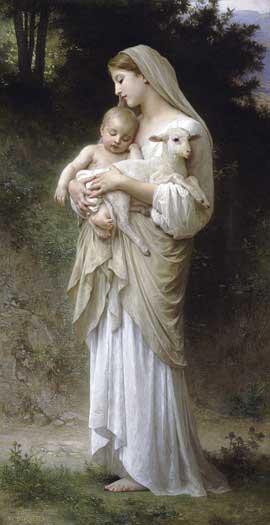
L'Innocence by William-Adolphe Bouguereau
L'Innocence by William-Adolphe Bouguereau
Monday, April 19, 2010
Practical advice

Saturday, March 20, 2010
Frank Duff Reveals His Thoughts on the True Devotion to Mary
"In my case I had not the degree of knowledge which would be necessary to absorb the True Devotion. Indeed it appeared to me to border on the absurd." Frank Duff
This article was first published in Maria Legionis in 1980.
Sometimes the True Devotion is viewed as a fad, but it is anything but that. The false idea is ministered to by the language of extreme devotion which is De Montfort's speciality. Sometimes he does appear to be speaking in terms of excess, but it is vital to recognise that there is no theological excess in his propositions. The notable fact that the new Holy Father should at the outset of his reign proclaim himself a follower of that Devotion should be enough to demonstrate this.
However, the circumstances that so many do not take it up, and that many are found who are opposed to it, is evidence that it presents certain difficulties and that it has to be explained. Perhaps I am in a good position myself for attempting that task because every possible difficulty presented itself to me when originally I came in touch with De Montfort's book. I think that these obstacles would normally have prevailed but things of an unusual character peremptorily intervened to reverse the balance.
So perhaps you will bear with this preamble. Not all prefaces have utility but I think this one has. So I ask your patience while I plough through the tale of my original contact with the Book at the age of about twenty-nine up to when I had not even as much as heard of De Montfort. The time was not long after the St. Vincent de Paul Society had acquired Myra House.
One evening I passed a group of the Brothers who were listening to one of their number talking. I stopped to listen and found that he had a book in his hands which he was animatedly discussing. It was the True Devotion. His description did not hold me but I did learn its name and its author. Although I did not realise it, that casual happening set off a chain-reaction of impulses or events which were destined to have important consequences for me. The first one came very shortly afterwards when I was looking through the shelves of one of the secondhand bookshops which at that time thronged the Quays.
I spotted a copy of the True Devotion and as sufficient curiosity had been awakened in me by the account I had so recently listened to, I bought it for the sum of four old pence. It proved to be a find in another direction; it was the first English edition of the True Devotion, translated by Father Faber and printed in Dublin. I still have it.
At once I proceeded to the reading of it. The result was a sort of crisis in me. I suppose that I would have regarded myself as having some devotion to Our Lady but it certainly did not surpass the dimension of the sentimental. It was what we were taught in the Catechism of the day. Mary was included in a general section on the Saints and we were told that it was "lawful" to be devout to her. In other words not a sin, a ludicrous description which would almost amount to placing it in the same category as backing horses or moderate drinking. With that grudging teaching it was remarkable that the popular attitude rose to what it did.
In my case I had not the degree of knowledge which would be necessary to absorb the True Devotion. Indeed it seemed to me to border on the absurd. But I did manage to persevere to the end. However I had had enough. I put it on a shelf and I do not think that I would ever have opened it again. My reading had created a prejudice against it.
But that was where the chain effect came into play. Very shortly afterwards I made the acquaintance of Tom Fallon, a leading member of the St. Vincent de Paul Society, a prominent Civil Servant, and altogether a remarkable personage. He died in Mexico some years ago at the age of about ninety-six. He had served there as a Priest from the early 19208, including the Obregon Persecution at its height.
A question which he very soon put to me was if I had read the True Devotion. My answer that I had, brought the further query: what did I think of it? Tom could be brusque in his manner and my reply that I had been unimpressed by the book brought down on me the suggestion that I had not read it with attention: that I had only skimmed through it. The book was a supreme classic in its field, necessary knowledge, arid it was due to myself that I understand it.
So I took the True Devotion in hand again and went carefully through it. The result was the same as before. There was an abyss between what it set forth and what I possessed. I so reported to Tom Fallon.
I now regard it as strange that he did not seek. to interrogate me in regard to the defects which bulked so big to me and which were not visible to him at all. How many times this performance was gone through of compelling a re-reading by me, I cannot precisely say. Let me put it at half a dozen times. No specific result seemed to emerge from each new reading, and yet each one appeared to have the quality of a step towards an objective. And that was exactly what things worked out to. I was engaged on the final forced reading when a sort of phenomenon accomplished itself. Without any process of thought leading up to it, something which I would but regard as a Divine favour was granted to me. It was the sudden realisation that the book was true. But why should this be? I did not understand things any more than I had previously. But there it was: a complete conviction that what I had been regarding as exaggerated and unreal was fully justified.
That moment has remained in my mind with an absolute clarity. I have only to think of it and it stands before me in its original startling complexion. In that moment I knew that the book was true.
What effect had this upon me? Very roughly I would say that it was twofold. I saw that the fault was mainly in myself. I lacked a whole field of knowledge in regard to Our Lady which was neccessary for the comprehending of her position as presented by the Saint. I would have to face up to the fact that I really knew nothing about her. The second part of this thought was that De Monfort was not writing for such as me but for a theologically educated class who possessed the foundation which the book required. He was presuming a knowledge of that foundation.
The point arises: Was Tom Fallon doing the same in regard to me? Was he making the mistake of supposing that I had the knowledge which would re-enable me to appreciate the book? And could that be the reason why at no stage did he probe or argue with me as to why I was not attuned to the book!
All these things thrashed around in my mind but finally settled into a peremptory conclusion. It was that I must get hold of the knowledge which De Monfort was presuming. In that stage things remained for a while. Not knowing exactly how to find what I wanted. I took no action.
But the action came. It imposed itself by virtue of that chain-reaction to which I have already referred. Perhaps its strikes a wrong note to say that it imposed itself on me. For when the transaction is analyzed I had in a sense earned the succession of links. I had followed up each one as it had presented itself. I had bought the book merely on the strength of hearing someone commend it to a group. I had then read it attentively. It was not my fault that I failed to get its message. When the next set of links, which were Tom Fallon's interventions, asserted themselves I yielded meekly in a manner which was not exactly typical of me. At the end of that particular series of links, perhaps it could be said that I had qualified to receive yet another impulse. Have I to point out that I was· discovering for myself the procedure which the Legion calls Symbolic Action or the 39 Steps. In difficulties take a step in faith. This sets in motion a succession of them until the crowning one arrives. The next step was a completely different type and in another field.
As an act of helpfulness to a friend I paid my first visit to Mount Melleray. The next chain-reaction met me so to speak on the monastery doorstep. The Guest Master asked me if I would wish to have some book. "A book". I exclaimed, his question producing quite a shock in me. "Oh yes, I do particularly want a book, I want one on the theology of the Blessed Virgin, one which is deep enough to give me the fullness of her position but at the same time simple enough for me to understand". He promised me to look around in their library.
Soon after he came to me with a book. It was entitled "The Knowledge of Mary" and it was by a Father Januarius de Concilio. It contained three hundred pages and a first glance through them suggested that it was rather deep. I started off at once on it. I had not gone far before I was seized with the same sort of excitement which had come to me when the True Devotion had suddenly revealed itself to me. Because de Concilio was the very thing that I was looking for. It was exactly for me. It was completely comprehensible but it was likewise most complete in what it taught on its subject. It began to unfold to me the entrancing but true eminence of the Woman on whom God had built His whole scheme from all eternity
It was the perfect introduction to the True Devotion. Nothing better from my point of view could be conceived. As I went on, it filled every gap and met every difficulty which had troubled me. The light that it afforded was so suitable to me that I could not but look on the book as rather a wondrous gift. As I have said, it was another emotional and intellectual experience for me.
But a great apprehension flooded into me. I saw this book as essential to me. I would be able to get through it during my stay in the monastery. But would I remember it? As it seemed to me, I could not afford to run the chance of being parted from it. I must be able to study it and perhaps leam it Off by heart. The title page told me that the book was published by a New York firm called Barclay in 1878. This was ominous. Would I be able to secure a copy? Strange to say, the idea of asking the monastery for a loan of the book did not occur to me. I was unknown to the monks, and I felt that there would be some firm rule against lending books from their library to birds of passage like myself. I did not even think of asking.
I had recourse to a counsel of desperation. I began to copy out practically its entire contents. At this I worked late and long. As I was also rising very early for the first Masses, this copying task was an immense burden, but it was peremptory. I did not dare to risk being deprived of that treasure of knowledge. However the exhaustion of the performance was repaid by the fact that it helped to fix indelibly in my memory all the wonderful material that it offered. As a total transaction I have assigned in my Marian philosophy an equal rating to those two books, De Montfort and De Concilio. It took the second one to open the first to me, so that I have always thought of them as interdependent halves in this teaching operation which turned my life upside down.
I am not here contending that the study of a book like de Concilio is now a necessary preliminary to the proper understanding of the True Devotion. I see very many persons around me take up the latter and read it with apparently a full appreciation. But this always puzzles me because not all of them have what I have been calling the foundation. Yet they eagerly received the illuminated picture which St. Louis-Marie projects of Mary and they gave it full play in their lives. I have to confess that I do not understand how this operates.
For legionaries, this whole problem hardly arises. The Handbook gives them the foundation in a simple form. Mary walks through its pages from the first to the last. The place assigned by God to her is adequately covered. In fact the Handbook can be regarded as a simplified but, all the same, elevated summary of such a book as de Concilio. Effort is made to include every phase of her being and to link it to aspects· of the legionary apostolate so that they explain each other, and in such fashion that Mary becomes the motive for each item of the apostolate. This is achieved so sufficiently as to produce in the ordinary body of the legionaries a limitless generosity and a veritable heroism. What I hesitantly describe as the selector half of the Legion are certainly giving themselves in a princely manner. There would appear to be nothing of which they are not capable. One is tempted to apply widely to the Legion the valuation given to the Chinese legionaries by Cardinal Riberi, namely that their stature is that of the first Christians, nothing less.
Actually the doctrine and fire of the True Devotion is so blended into the Legion Handbook that even if the True Devotion was not being mentioned, it would still amount to much the same thing. It is an interesting circumstance that persons who reject the True Devotion are found accepting the Handbook without the slightest demur. They recoil from the De Montfort Consecration but they recite with readiness the Legion Promise which is just as wholesale as the Consecration.
In these circumstances the Legion could no doubt get along without the True Devotion, and of course in many places it has to do so by reason of its being unavailable in the particular languages. But this is due to the amount that the Legion has already sucked into its bloodstream from the True Devotion. This is a continuing process. Much more remains to be assimilated? The fact is that one cannot emphasise too much the value of the True Devotion as a supplement to the Handbook and the entire Legion system. St. Louis-Marie's words of fire uplift Our Lady from the level of pure doctrine and give her substance as a person, our Mother with intimate charge of our lives, utterly indispensable to us, our Queen, our leader, the very thought of whom inspires courage and stimulates one to undertake the impossible.
Apart altogether from the special relation which the True Devotion would have towards the Legion, the book should be read for its uniqueness. Among the works written on the Blessed Virgin there is no other even remotely like it. One cannot name another and say: this is second! It just stands out like a pillar on a hill.
Such being the Legion's valuation of the book, it would form a disastrous position if many legionaries are not giving it a proper place in their lives, because the loss to themselves is thereby great.
Furthermore it must not be thought that the cause of Our Lady is now so firm as to need no defenders. The opposite is the case, a most strange position having produced itself as the result of Vatican II. That body proposed as one of its principal aims to elevate common Mariological teaching to the point which the operations of the Legion had shown to be within the reach of the ordinary people. To that end it composed Chapter VIII of the De Ecclesia Decree which brought things up to the level which the Legion had been teaching its members, while at the same time not exceeding that level. This is intriguing as indicating that the Council considered that the Legion afforded a norm as to what the ordinary rank and file of the Church was capable of receiving.
Nevertheless the unexpected sequel followed of a set-back in regard to Marian devotion. This is peculiar in view of the advanced teaching of Chapter VIII. It can only be explained by the fact that the Council had decided to substitute for a separate decree on the subject of Our Lady, a chapter in the Decree on the Church. A specious deduction would be that a chapter is less than a Decree. Also one has to be more reserved in a general Decree in order to maintain due proportion. But the gain from being so emphatically set out as part of essential Church doctrine far out weighs the loss of separateness. Of course time will soon redress the bal- ance. In the meantime the presence of the Legion in the field has assumed an added importance. It is the special custodian and propagator among the people of the correct role of Our Lady. For this reason the Legion must give special heed and prominence to the True Devotion as a sovereign means of maintaining its own spirit.
So far I have been speaking in general terms of the True Devotion, more of its quality as a proclamation about Mary than as a special devotion to her. But the book declares its purpose to be the establishment of a system of devotion to her. It calls this the Slavery or total consecration to Our Lady. It is an anomaly that thereby the book places certain difficulties in its own way. Many persons are alienated from the devotion and consecration by practices which the Saint recommends and for this reason turn away from the book itself.
This is unfortunate for every reason. A particular reason is that the essential of his Devotion does not consist in the things which those people recoil from but in its abiding spirit of unity and dependence on Our Lady.
The word "Slavery" evokes among some an irrational antipathy as if we were obliged to adopt the mentality of an earthly slavery. Also De Montfort's prescribing of the wearing of a chain to keep us in mind of our subjection to Our Lady stirs up dislike.
I point out that if this attitude of sheer sentimentality were allowed to run away with things, it could tell with equivalent force against our use of the Crucifix. Why do not those objectors rail against it as introducing into our minds a disgraceful and out-of-date barbarism associated with vile criminals and their dire punishment? But it is for that very reason that we are devoted to the Crucifix; it makes vivid to us what Jesus took on Himself for our sake. I repeat that the chains and penitential practices proposed by 51. Louis-Marie are not essential to his Devotion. But certainly they cannot be ruled out as aids towards the acquiring of the central idea which is that of a realization of our total dependence on Mary, our Mother. God Himself has placed us in that condition and it extends to extremes far beyond our capacity to measure them. Slavery may seem to be a deprived state, but as the Handbook points out, it leaves the mind and soul free and is little in comparison with the extremity of union dependence and love which we should endeavour to cultivate in ourselves towards our exquisite Queen and Mother. This is due from us as part of our ordinary Catholic state and not because St. Louis Marie de Montfort enjoins it. His position is that of reminding us that it is due from us, rather than of imposing it on us.
In that same sense that it is the inner spirit of the Devotion that counts more than the practices which are entailed, the very form of Consecration recommended by the True Devotion could be left out. But this would be going too far in the opposite direction and would risk in the end our slipping out of the Devotion altogether. We are composed of body and spirit, and each lives out of the other. Therefore the True Devotion for reality and permanence must possess some bodily or tangible form.
As to the taking on of the Devotion in some practical way, I could not speak too strongly. In the first place I have seen the Legion itself arise at the mere touch of De Montfort on an interested group. At once that band expanded into the Legion. Of course he must have been keeping a sort of vigil, awaiting that moment ever since he prophesied it more than two hundred years previously. "I look forward", he says, "to a great legion of brave and valiant soldiers of Jesus and Mary, of both sexes, to combat the world, the devil and corrupted nature in those more than ever perilous times which are to come".
But the union between the Legion and the Saint went further than his breathing of life into it. He would have to continue to nurture it, and the Legion should of necessity admit its obligation to him. In a strange and potent fashion the Legion was enabled to do this. Though he had died in 1716 in the odour of sanctity, his Cause for Canonization, lagged on the way and seemed to come to a standstill with his Beatification by Leo XIII. But the spread of the Legion out over the world made him one of the most invoked Saints in the Church and supplied what had been the missing element, the popular estimation or cultus. And at once Rome acted. Not only was he canonized in 1950 but his statue was placed in a lordly position in St. Peter's, prominent amongst the greatest ones.
Now may I put the question: what is the best way to read his book and to practice his Devotion, for these operations must go together as a twin. I would be inclined to say that the very best method would lie in the reading of a page of the True Devotion every day, but in the manner of a prayer or meditation, seeking to drain the idea and spirit even of each word into our minds, accepting what it declares as a message to us from him; rejecting the notion that the very strong expressions which all the time proceed from his lips about the Blessed Virgin represent in the slightest degree unjustified embellishment of her. For there I think is the very charm and virtue of the book: that it can appear so often to be parting company from reality and plunging into a fantastic, extravagant world of its own. But beware when you find yourself imagining that such is the case. Because there is no exaggeration and no fantasy. No book ever passed through such an ordeal by fire and emerged so triumphantly as this one has.
Moreover Mary's vastness exceeds our capacity to exaggerate her. Our intelligence really cannot compass her. Necessarily God's masterpiece evades our full understanding so that when luminous glimpses are afforded to us we find the light too much.
So again I urge it. Read the book regularly in the spirit of complete acceptance. Dwell on its different parts. Capture its soaring ideas and receive them into yourself as by very faith. In this way will the real Mary show herself to you and be able to exert her full maternal sway over you. Thus will you make your passage through this life worthwhile, what it is supposed to be.
Frank Duff
From Legion of Mary Senatus of Ontario
Subscribe to:
Posts (Atom)


