 |
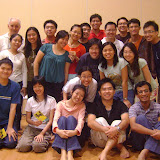
| 16.1.09 to 18.1.09 - Legion Retreat |
And here are the Pauls engaged in a battle of minds (click on the "thumb"nail for the video):
 |
| From 16.1.09 to 18.1.09 - Legion Retreat |

|
| 16.1.09 to 18.1.09 - Legion Retreat |
|
| From 16.1.09 to 18.1.09 - Legion Retreat |
I found this list via Slashdot and here is a sample.
C would be Judaism - it's old and restrictive, but most of the world is familiar with its laws and respects them. The catch is, you can't convert into it - you're either into it from the start, or you will think that it's insanity. Also, when things go wrong, many people are willing to blame the problems of the world on it.
Java would be Fundamentalist Christianity - it's theoretically based on C, but it voids so many of the old laws that it doesn't feel like the original at all. Instead, it adds its own set of rigid rules, which its followers believe to be far superior to the original. Not only are they certain that it's the best language in the world, but they're willing to burn those who disagree at the stake.
PHP would be Cafeteria Christianity - Fights with Java for the web market. It draws a few concepts from C and Java, but only those that it really likes. Maybe it's not as coherent as other languages, but at least it leaves you with much more freedom and ostensibly keeps the core idea of the whole thing. Also, the whole concept of "goto hell" was abandoned.
C++ would be Islam - It takes C and not only keeps all its laws, but adds a very complex new set of laws on top of it. It's so versatile that it can be used to be the foundation of anything, from great atrocities to beautiful works of art. Its followers are convinced that it is the ultimate universal language, and may be angered by those who disagree. Also, if you insult it or its founder, you'll probably be threatened with death by more radical followers.
C# would be Mormonism - At first glance, it's the same as Java, but at a closer look you realize that it's controlled by a single corporation (which many Java followers believe to be evil), and that many theological concepts are quite different. You suspect that it'd probably be nice, if only all the followers of Java wouldn't discriminate so much against you for following it.
Perl would be Voodoo - An incomprehensible series of arcane incantations that involve the blood of goats and permanently corrupt your soul. Often used when your boss requires you to do an urgent task at 21:00 on Friday night.
Fairly funny list, though Perl was written by a Christian and taken from a biblical reference to the "Pearl of great price" so Voodoo isn't quite fair.
Strangely though their was no language referenced for the Catholic Church. I guess it would be pretty hard to link the Church to one specific language. As someone who writes code for a living this question though is write up my alley. Besides the episcopal jurisdiction of the Bishop of Rome is the head of the Holy C.
At first thought I would think Pascal could be it since it is named after French mathematician and philosopher Blaise Pascal who was certainly a believing Catholic who wrote the great theological work the Pensées. Pacal has strong typing and I do like a dogmatically typed language where an object stays that type of object without explicit conversion. Begin and end keywords reminds me of the Alpha and Omega. Pascal just does not go far enough to resemble the Church.
Now a programming language that reflected the Catholic Church would be a cross between Basic and machine language. Basic gives it the James Joyce 'here comes everybody' aspect and machine language would give it the direct access to God that we have through the Eucharist. The Catholic Church can nourish anybody from the humblest peasant to the most brilliant theologian. Like most languages an interpreter is required for compiled code. In computing if you don't have a valid interpreter/compiler the code you write will end up either doing nothing or not what you intended. The teaching magisterium of the Church gives us that interpreter in real life. A good interpreter/compiler also has lots of error checking. On our own we are often prone to errors and so being informed of our errors is to our good to ensure that we write valid code. Often we think we are writing valid code only to find that when we go to build it something is not exactly right. You can't just tell the interpreter/compiler you are sorry for writing bad code, you have to repent of your coding error and fix it.
Now what would we call a programming language similar to the Catholic Church? How about C†† (pronounced C Cross Cross). Like St. Paul the Church teaches Christ crucified and the cross is never missing from our lives. The C of course stands for Catholic and the universal binary that the code produces. The universal binary is of course accessible by all operating systems. Though while we see the good that is common to many programming languages we hope that all will come to accept the fullness of C††. As programmers we don't want to be triumphalists, but to help to spread the good code to every nation.
The basics of the language C†† would be fixed. Though interfaces can be later added on that help to access the underlying language. The code structures would be based both on apostolic programming tradition and the reference book. The compiler also known as the magisterium would rely on the CDF (Coding for the Doctrine of the Flow) to ensure wayward code was corrected and brought back into fullness of the code specification. When bad code is detected the compiler would throw an anathema.
C†† would certainly be strongly typed. An object created yesterday or even a thousand years ago would remain exactly the same object today. Though this does not mean that we can not understand an object more deeply over time, only that an integer value will not become a string just because it is currently fashionable in the culture for this to be true. What is set to a state of true today remains true tomorrow. For example this is how you would set a true and a false value in C††.
boolean item = dogma;
boolean item2 = heresy;
Other keywords include Fashion (which can hold any value, but is not used for anything serious), Absolute (which holds one constant value that never changes), Discipline (value can change over time based on a prudential decision), Hierarchy (An ordered data structure).
Multiple coding styles known as rites can be used to write the code. These rites though will all compile to exactly the same code whether using an Eastern or Western style. Some traditional programmers prefer to only program in Latin, but you can choose a vernacular language as long as you don't use and edition approved by ICEL in the seventies which does not give the full nuances of the keywords.
The reference for C†† would be maintained by the Vaticode. The head programmer/maintainer at the Vaticode is called His Geekiness and he has final say on the language definition and its interpretation. The Vicar of Code is infallible only when speaking on code and compilers. The Nerds in union with His Geekiness are the authentic teachers of the language. New definitions can be added to the language that conform to the reference and apostolic programmers. Sometimes a movement among programmers (geekus fidelum) can lead to the Vaticode adding a new definition.
Here is a sample "Hello World" program in C††
faith()
{
works()
{
print("Let there be light");
}
}
After all "Let there be light" was the original Hello World program by the Divine Programmer. Every C†† requires a "faith" method which is the main entry point to the program. Remember faith() without works() and your code is dead.
If only there was a programming language like the Catholic Church. Right now there are so many denominations of programming languages that keep splitting. Like C+ going into schism from C and then C++ going into schism from C+. I pray that there be but one language.
 |
The exact origin of the “O Antiphons” is not known. Boethius (c. 480-524) made a slight reference to them, thereby suggesting their presence at that time. At the Benedictine abbey of Fleury (now Saint-Benoit-sur-Loire), these antiphons were recited by the abbot and other abbey leaders in descending rank, and then a gift was given to each member of the community. By the eighth century, they are in use in the liturgical celebrations in Rome. The usage of the “O Antiphons” was so prevalent in monasteries that the phrases, “Keep your O” and “The Great O Antiphons” were common parlance. One may thereby conclude that in some fashion the “O Antiphons” have been part of our liturgical tradition since the very early Church.
The importance of “O Antiphons” is twofold: Each one highlights a title for the Messiah: O Sapientia (O Wisdom), O Adonai (O Lord), O Radix Jesse (O Root of Jesse), O Clavis David (O Key of David), O Oriens (O Rising Sun), O Rex Gentium (O King of the Nations), and O Emmanuel. Also, each one refers to the prophecy of Isaiah of the coming of the Messiah. Let’s now look at each antiphon with just a sample of Isaiah’s related prophecies :
O Sapientia: “O Wisdom, O holy Word of God, you govern all creation with your strong yet tender care. Come and show your people the way to salvation.” Isaiah had prophesied, “The spirit of the Lord shall rest upon him: a spirit of wisdom and of understanding, a spirit of counsel and of strength, a spirit of knowledge and fear of the Lord, and his delight shall be the fear of the Lord.” (11:2-3), and “Wonderful is His counsel and great is His wisdom.” (28:29).O Adonai: “O sacred Lord of ancient Israel, who showed yourself to Moses in the burning bush, who gave him the holy law on Sinai mountain: come, stretch out your mighty hand to set us free.” Isaiah had prophesied, “But He shall judge the poor with justice, and decide aright for the land’s afflicted. He shall strike the ruthless with the rod of his mouth, and with the breath of his lips he shall slay the wicked. Justice shall be the band around his waist, and faithfulness a belt upon his hips.” (11:4-5); and “Indeed the Lord will be there with us, majestic; yes the Lord our judge, the Lord our lawgiver, the Lord our king, he it is who will save us.” (33:22).
O Radix Jesse: “O Flower of Jesse’s stem, you have been raised up as a sign for all peoples; kings stand silent in your presence; the nations bow down in worship before you. Come, let nothing keep you from coming to our aid.” Isaiah had prophesied, “But a shoot shall sprout from the stump of Jesse, and from his roots a bud shall blossom.” (11:1), and A On that day, the root of Jesse, set up as a signal for the nations, the Gentiles shall seek out, for his dwelling shall be glorious.” (11:10). Remember also that Jesse was the father of King David, and Micah had prophesied that the Messiah would be of the house and lineage of David and be born in David’s city, Bethlehem (Micah 5:1).
O Clavis David: “O Key of David, O royal Power of Israel controlling at your will the gate of Heaven: Come, break down the prison walls of death for those who dwell in darkness and the shadow of death; and lead your captive people into freedom.” Isaiah had prophesied, AI will place the Key of the House of David on His shoulder; when he opens, no one will shut, when he shuts, no one will open.” (22:22), and “His dominion is vast and forever peaceful, from David’s throne, and over His kingdom, which he confirms and sustains by judgment and justice, both now and forever.” (9:6). O Oriens: “O Radiant Dawn, splendor of eternal light, sun of justice: come, shine on those who dwell in darkness and the shadow of death.” Isaiah had prophesied, “The people who walked in darkness have seen a great light; upon those who dwelt in the land of gloom a light has shown.” (9:1).
O Rex Gentium: “O King of all the nations, the only joy of every human heart; O Keystone of the mighty arch of man, come and save the creature you fashioned from the dust.” Isaiah had prophesied, “For a child is born to us, a son is given us; upon his shoulder dominion rests. They name him Wonder-Counselor, God-Hero, Father-Forever, Prince of Peace.” (9:5), and “He shall judge between the nations, and impose terms on many peoples. They shall beat their swords into plowshares and their spears into pruning hooks; one nation shall not raise the sword against another, nor shall they train for war again.” (2:4) .
O Emmanuel: “O Emmanuel, king and lawgiver, desire of the nations, Savior of all people, come and set us free, Lord our God.” Isaiah had prophesied, “The Lord himself will give you this sign: the Virgin shall be with child, and bear a son, and shall name him Emmanuel.”
(7:14). Remember “Emmanuel” means “God is with us.”
According to Professor Robert Greenberg of the San Francisco Conservatory of Music, the Benedictine monks arranged these antiphons with a definite purpose. If one starts with the last title and takes the first letter of each one - Emmanuel, Rex, Oriens, Clavis, Radix, Adonai, Sapientia - the Latin words ero cras are formed, meaning, “Tomorrow, I will come.” Therefore, the Lord Jesus, whose coming we have prepared for in Advent and whom we have addressed in these seven Messianic titles, now speaks to us, “Tomorrow, I will come.” So the “O Antiphons” not only bring intensity to our Advent preparation, but bring it to a joyful conclusion.

ACKNOWLEDGEMENT
Saunders, Rev. William. “What are the ‘O Antiphons’?” Arlington Catholic Herald.
Reprinted with permission of the Arlington Catholic Herald.
THE AUTHOR
 |
Copyright © 2003 Arlington Catholic Herald
| Latin | English |
|---|---|
| Gaudete, gaudete! Christus est natus Ex Maria virgine, gaudete! | Rejoice, rejoice! Christ is born Of the Virgin Mary, rejoice! |
| Tempus adest gratiæ Hoc quod optabamus, Carmina lætitiæ Devote reddamus. | The time of grace has come That we have desired; Let us devoutly return Joyful verses. |
| Deus homo factus est Natura mirante, Mundus renovatus est A Christo regnante. | God has become man, And nature marvels; The world has been renewed By Christ who is King. |
| Ezechielis porta Clausa pertransitur, Unde lux est orta Salus invenitur. | The closed gate of Ezechiel Has been passed through; Whence the light is born, Salvation is found. |
| Ergo nostra cantio, Psallat iam in lustro; Benedicat Domino: Salus Regi nostro. | Therefore let our song Now be sung in brightness Let it give praise to the Lord: Greeting to our King. |


