
Support the Holy Father and pray with him!
"Young people in particular, I appeal to you: bear witness to your faith through the digital world!"
-Pope Benedict XVI

-Pope Benedict XVI

Showing posts with label Pope Benedict XVI. Show all posts
Showing posts with label Pope Benedict XVI. Show all posts
Monday, April 19, 2010
Practical advice

Friday, December 25, 2009
"Let us go there!"
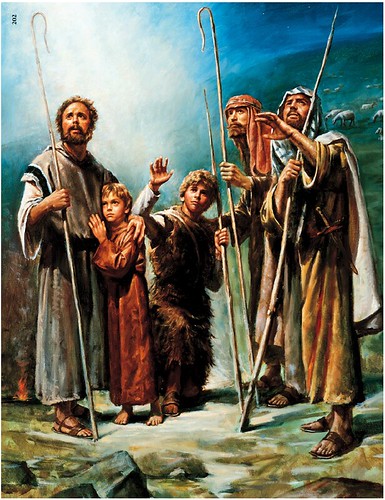
In all kinds of ways, God has to prod us and reach out to us again and again, so that we can manage to escape from the muddle of our thoughts and activities and discover the way that leads to him. But a path exists for all of us. The Lord provides everyone with tailor-made signals. He calls each one of us, so that we too can say: "Come on, ‘let us go over’ to Bethlehem – to the God who has come to meet us. Yes indeed, God has set out towards us. Left to ourselves we could not reach him. The path is too much for our strength. But God has come down. He comes towards us. He has travelled the longer part of the journey. Now he invites us: come and see how much I love you. Come and see that I am here. Transeamus usque Bethlehem, the Latin Bible says. Let us go there!
- from Pope Benedict's 2009 Christmas sermon
Monday, August 3, 2009
Wednesday, July 15, 2009
Caritas in Veritate--in small doses
Fidelity to man requires fidelity to the truth, which alone is the guarantee of freedom (cf. Jn 8:32) and of the possibility of integral human development. For this reason the Church searches for truth, proclaims it tirelessly and recognizes it wherever it is manifested. This mission of truth is something that the Church can never renounce. Her social doctrine is a particular dimension of this proclamation: it is a service to the truth which sets us free. Open to the truth, from whichever branch of knowledge it comes, the Church's social doctrine receives it, assembles into a unity the fragments in which it is often found, and mediates it within the constantly changing life-patterns of the society of peoples and nations.
Tuesday, July 7, 2009
Pope Benedict's new encyclical: Caritas in Veritate
The Pope's new encyclical has finally been released!
ENCYCLICAL LETTER
CARITAS IN VERITATE
OF THE SUPREME PONTIFF
BENEDICT XVI
TO THE BISHOPS
PRIESTS AND DEACONS
MEN AND WOMEN RELIGIOUS
THE LAY FAITHFUL
AND ALL PEOPLE OF GOOD WILL
ON INTEGRAL HUMAN DEVELOPMENT
IN CHARITY AND TRUTH
INTRODUCTION
1. Charity in truth, to which Jesus Christ bore witness by his earthly life and especially by his death and resurrection, is the principal driving force behind the authentic development of every person and of all humanity. Love — caritas — is an extraordinary force which leads people to opt for courageous and generous engagement in the field of justice and peace. It is a force that has its origin in God, Eternal Love and Absolute Truth. Each person finds his good by adherence to God's plan for him, in order to realize it fully: in this plan, he finds his truth, and through adherence to this truth he becomes free (cf. Jn 8:22). To defend the truth, to articulate it with humility and conviction, and to bear witness to it in life are therefore exacting and indispensable forms of charity.
Sunday, April 19, 2009
Fourth Anniversary of the Election of Pope Benedict XVI

Lord, source of eternal life and truth, give to Your shepherd, Pope Benedict XVI, a spirit of courage and right judgement, a spirit of knowledge and love.
By governing with fidelity those entrusted to his care may he, as successor to the apostle Peter and vicar of Christ, build Your church into a sacrament of unity, love, and peace for all the world.
We ask this through our Lord Jesus Christ, Your Son, Who lives and reigns with You and the Holy Spirit, one God, forever and ever. Amen.

Viva il Papa!
Thursday, April 16, 2009
Happy 82nd Birthday, Your Holiness!
 God of all creation, we offer you grateful praise for the gift of life. Hear the prayers of Pope Benedict, your servant, who recalls today the day of his birth and rejoices in your gifts of life and love, family and friends. Bless him with your presence and surround him with your love that he may enjoy many happy years, all of them pleasing to you. We ask this through Christ our Lord. Amen. Viva il Papa! |


Sunday, April 12, 2009
Homily of Pope Benedict XVI on Easter Sunday
Dear Brothers and Sisters,
“Christ, our Paschal lamb, has been sacrificed!” (1 Cor 5:7). On this day, Saint Paul’s triumphant words ring forth, words that we have just heard in the second reading, taken from his First Letter to the Corinthians. It is a text which originated barely twenty years after the death and resurrection of Jesus, and yet – like many Pauline passages – it already contains, in an impressive synthesis, a full awareness of the newness of life in Christ. The central symbol of salvation history – the Paschal lamb – is here identified with Jesus, who is called “our Paschal lamb”. The Hebrew Passover, commemorating the liberation from slavery in Egypt, provided for the ritual sacrifice of a lamb every year, one for each family, as prescribed by the Mosaic Law. In his passion and death, Jesus reveals himself as the Lamb of God, “sacrificed” on the Cross, to take away the sins of the world. He was killed at the very hour when it was customary to sacrifice the lambs in the Temple of Jerusalem. The meaning of his sacrifice he himself had anticipated during the Last Supper, substituting himself – under the signs of bread and wine – for the ritual food of the Hebrew Passover meal. Thus we can truly say that Jesus brought to fulfilment the tradition of the ancient Passover, and transformed it into his Passover.
On the basis of this new meaning of the Paschal feast, we can also understand Saint Paul’s interpretation of the “leaven”. The Apostle is referring to an ancient Hebrew usage: according to which, on the occasion of the Passover, it was necessary to remove from the household every tiny scrap of leavened bread. On the one hand, this served to recall what had happened to their forefathers at the time of the flight from Egypt: leaving the country in haste, they had brought with them only unleavened bread. At the same time, though, the “unleavened bread” was a symbol of purification: removing the old to make space for the new. Now, Saint Paul explains, this ancient tradition likewise acquires a new meaning, once more derived from the new “Exodus”, which is Jesus’ passage from death to eternal life. And since Christ, as the true Lamb, sacrificed himself for us, we too, his disciples – thanks to him and through him – can and must be the “new dough”, the “unleavened bread”, liberated from every residual element of the old yeast of sin: no more evil and wickedness in our heart.
“Let us celebrate the feast … with the unleavened bread of sincerity and truth”. This exhortation from Saint Paul, which concludes the short reading that was proclaimed a few moments ago, resounds even more powerfully in the context of the Pauline Year. Dear brothers and sisters, let us accept the Apostle’s invitation; let us open our spirit to Christ, who has died and is risen in order to renew us, in order to remove from our hearts the poison of sin and death, and to pour in the life-blood of the Holy Spirit: divine and eternal life. In the Easter Sequence, in what seems almost like a response to the Apostle’s words, we sang: “Scimus Christum surrexisse a mortuis vere” – we know that Christ has truly risen from the dead. Yes, indeed! This is the fundamental core of our profession of faith; this is the cry of victory that unites us all today. And if Jesus is risen, and is therefore alive, who will ever be able to separate us from him? Who will ever be able to deprive us of the love of him who has conquered hatred and overcome death?
The Easter proclamation spreads throughout the world with the joyful song of the Alleluia. Let us sing it with our lips, and let us sing it above all with our hearts and our lives, with a manner of life that is “unleavened”, that is to say, simple, humble, and fruitful in good works. “Surrexit Christus spes mea: precedet suos in Galileam” – Christ my hope is risen, and he goes before you into Galilee. The Risen One goes before us and he accompanies us along the paths of the world. He is our hope, He is the true peace of the world. Amen!
The Holy Father's Homily at Easter Vigil
Saint Mark tells us in his Gospel that as the disciples came down from the Mount of the Transfiguration, they were discussing among themselves what "rising from the dead" could mean (cf. Mk 9:10). A little earlier, the Lord had foretold his passion and his resurrection after three days. Peter had protested against this prediction of death. But now, they were wondering what could be meant by the word "resurrection". Could it be that we find ourselves in a similar situation? Christmas, the birth of the divine Infant, we can somehow immediately comprehend. We can love the child, we can imagine that night in Bethlehem, Mary's joy, the joy of Saint Joseph and the shepherds, the exultation of the angels. But what is resurrection? It does not form part of our experience, and so the message often remains to some degree beyond our understanding, a thing of the past. The Church tries to help us understand it, by expressing this mysterious event in the language of symbols in which we can somehow contemplate this astonishing event. During the Easter Vigil, the Church points out the significance of this day principally through three symbols: light, water, and the new song - the Alleluia.
First of all, there is light. God's creation - which has just been proclaimed to us in the Biblical narrative - begins with the command: "Let there be light!" (Gen 1:3). Where there is light, life is born, chaos can be transformed into cosmos. In the Biblical message, light is the most immediate image of God: He is total Radiance, Life, Truth, Light. During the Easter Vigil, the Church reads the account of creation as a prophecy. In the resurrection, we see the most sublime fulfilment of what this text describes as the beginning of all things. God says once again: "Let there be light!" The resurrection of Jesus is an eruption of light. Death is conquered, the tomb is thrown open. The Risen One himself is Light, the Light of the world. With the resurrection, the Lord's day enters the nights of history. Beginning with the resurrection, God's light spreads throughout the world and throughout history. Day dawns. This Light alone - Jesus Christ - is the true light, something more than the physical phenomenon of light. He is pure Light: God himself, who causes a new creation to be born in the midst of the old, transforming chaos into cosmos.
Let us try to understand this a little better. Why is Christ Light? In the Old Testament, the Torah was considered to be like the light coming from God for the world and for humanity. The Torah separates light from darkness within creation, that is to say, good from evil. It points out to humanity the right path to true life. It points out the good, it demonstrates the truth and it leads us towards love, which is the deepest meaning contained in the Torah. It is a "lamp" for our steps and a "light" for our path (cf. Ps 119:105). Christians, then, knew that in Christ, the Torah is present, the Word of God is present in him as Person. The Word of God is the true light that humanity needs. This Word is present in him, in the Son. Psalm 19 had compared the Torah to the sun which manifests God's glory as it rises, for all the world to see. Christians understand: yes indeed, in the resurrection, the Son of God has emerged as the Light of the world. Christ is the great Light from which all life originates. He enables us to recognize the glory of God from one end of the earth to the other. He points out our path. He is the Lord's day which, as it grows, is gradually spreading throughout the earth. Now, living with him and for him, we can live in the light.
At the Easter Vigil, the Church represents the mystery of the light of Christ in the sign of the Paschal candle, whose flame is both light and heat. The symbolism of light is connected with that of fire: radiance and heat, radiance and the transforming energy contained in the fire - truth and love go together. The Paschal candle burns, and is thereby consumed: Cross and resurrection are inseparable. From the Cross, from the Son's self-giving, light is born, true radiance comes into the world. From the Paschal candle we all light our own candles, especially the newly baptized, for whom the light of Christ enters deeply into their hearts in this Sacrament. The early Church described Baptism as fotismos, as the Sacrament of illumination, as a communication of light, and linked it inseparably with the resurrection of Christ. In Baptism, God says to the candidate: "Let there be light!" The candidate is brought into the light of Christ. Christ now divides the light from the darkness. In him we recognize what is true and what is false, what is radiance and what is darkness. With him, there wells up within us the light of truth, and we begin to understand. On one occasion when Christ looked upon the people who had come to listen to him, seeking some guidance from him, he felt compassion for them, because they were like sheep without a shepherd (cf. Mk 6:34). Amid the contradictory messages of that time, they did not know which way to turn. What great compassion he must feel in our own time too - on account of all the endless talk that people hide behind, while in reality they are totally confused. Where must we go? What are the values by which we can order our lives? The values by which we can educate our young, without giving them norms they may be unable to resist, or demanding of them things that perhaps should not be imposed upon them? He is the Light. The baptismal candle is the symbol of enlightenment that is given to us in Baptism. Thus at this hour, Saint Paul speaks to us with great immediacy. In the Letter to the Philippians, he says that, in the midst of a crooked and perverse generation, Christians should shine as lights in the world (cf. Phil 2:15). Let us pray to the Lord that the fragile flame of the candle he has lit in us, the delicate light of his word and his love amid the confusions of this age, will not be extinguished in us, but will become ever stronger and brighter, so that we, with him, can be people of the day, bright stars lighting up our time.
The second symbol of the Easter Vigil - the night of Baptism - is water. It appears in Sacred Scripture, and hence also in the inner structure of the Sacrament of Baptism, with two opposed meanings. On the one hand there is the sea, which appears as a force antagonistic to life on earth, continually threatening it; yet God has placed a limit upon it. Hence the book of Revelation says that in God's new world, the sea will be no more (cf. 21:1). It is the element of death. And so it becomes the symbolic representation of Jesus' death on the Cross: Christ descended into the sea, into the waters of death, as Israel did into the Red Sea. Having risen from death, he gives us life. This means that Baptism is not only a cleansing, but a new birth: with Christ we, as it were, descend into the sea of death, so as to rise up again as new creatures.
The other way in which we encounter water is in the form of the fresh spring that gives life, or the great river from which life comes forth. According to the earliest practice of the Church, Baptism had to be administered with water from a fresh spring. Without water there is no life. It is striking how much importance is attached to wells in Sacred Scripture. They are places from which life rises forth. Beside Jacob's well, Christ spoke to the Samaritan woman of the new well, the water of true life. He reveals himself to her as the new, definitive Jacob, who opens up for humanity the well that is awaited: the inexhaustible source of life-giving water (cf. Jn 4:5-15). Saint John tells us that a soldier with a lance struck the side of Jesus, and from his open side - from his pierced heart - there came out blood and water (cf. Jn 19:34). The early Church saw in this a symbol of Baptism and Eucharist flowing from the pierced heart of Jesus. The prophet Ezekiel saw a vision of the new Temple from which a spring issues forth that becomes a great life-giving river (cf. Ezek 47:1-12). In a land which constantly suffered from drought and water shortage, this was a great vision of hope. Nascent Christianity understood: in Christ, this vision was fulfilled. He is the true, living Temple of God. He is the spring of living water. From him, the great river pours forth, which in Baptism renews the world and makes it fruitful; the great river of living water, his Gospel which makes the earth fertile. In a discourse during the Feast of Tabernacles, though, Jesus prophesied something still greater: "Whoever believes in me ... out of his heart shall flow rivers of living water" (Jn 7:38). In Baptism, the Lord makes us not only persons of light, but also sources from which living water bursts forth. We all know people like that, who leave us somehow refreshed and renewed; people who are like a fountain of fresh spring water. We do not necessarily have to think of great saints like Augustine, Francis of Assisi, Teresa of Avila, Mother Teresa of Calcutta and so on, people through whom rivers of living water truly entered into human history. Thanks be to God, we find them constantly even in our daily lives: people who are like a spring. Certainly, we also know the opposite: people who spread around themselves an atmosphere like a stagnant pool of stale, or even poisoned water. Let us ask the Lord, who has given us the grace In his death, Jesus himself became the spring.of Baptism, for the gift always to be sources of pure, fresh water, bubbling up from the fountain of his truth and his love!
The third great symbol of the Easter Vigil is something rather different; it has to do with man himself. It is the singing of the new song - the alleluia. When a person experiences great joy, he cannot keep it to himself. He has to express it, to pass it on. But what happens when a person is touched by the light of the resurrection, and thus comes into contact with Life itself, with Truth and Love? He cannot merely speak about it. Speech is no longer adequate. He has to sing. The first reference to singing in the Bible comes after the crossing of the Red Sea. Israel has risen out of slavery. It has climbed up from the threatening depths of the sea. It is as it were reborn. It lives and it is free. The Bible describes the people's reaction to this great event of salvation with the verse: "The people ... believed in the Lord and in Moses his servant" (Ex 14:31). Then comes the second reaction which, with a kind of inner necessity, follows from the first one: "Then Moses and the Israelites sang this song to the Lord ..." At the Easter Vigil, year after year, we Christians intone this song after the third reading, we sing it as our song, because we too, through God's power, have been drawn forth from the water and liberated for true life.
There is a surprising parallel to the story of Moses' song after Israel's liberation from Egypt upon emerging from the Red Sea, namely in the Book of Revelation of Saint John. Before the beginning of the seven last plagues imposed upon the earth, the seer has a vision of something "like a sea of glass mingled with fire; and those who had conquered the beast and its image and the number of its name, standing beside the sea of glass with harps of God in their hands. And they sing the song of Moses, the servant of God, and the song of the Lamb ..." (Rev 15:2f.). This image describes the situation of the disciples of Jesus Christ in every age, the situation of the Church in the history of this world. Humanly speaking, it is self-contradictory. On the one hand, the community is located at the Exodus, in the midst of the Red Sea, in a sea which is paradoxically ice and fire at the same time. And must not the Church, so to speak, always walk on the sea, through the fire and the cold? Humanly speaking, she ought to sink. But while she is still walking in the midst of this Red Sea, she sings - she intones the song of praise of the just: the song of Moses and of the Lamb, in which the Old and New Covenants blend into harmony. While, strictly speaking, she ought to be sinking, the Church sings the song of thanksgiving of the saved. She is standing on history's waters of death and yet she has already risen. Singing, she grasps at the Lord's hand, which holds her above the waters. And she knows that she is thereby raised outside the force of gravity of death and evil - a force from which otherwise there would be no way of escape - raised and drawn into the new gravitational force of God, of truth and of love. At present she is still between the two gravitational fields. But once Christ is risen, the gravitational pull of love is stronger than that of hatred; the force of gravity of life is stronger than that of death. Perhaps this is actually the situation of the Church in every age? It always seems as if she ought to be sinking, and yet she is always already saved. Saint Paul illustrated this situation with the words: "We are as dying, and behold we live" (2 Cor 6:9). The Lord's saving hand holds us up, and thus we can already sing the song of the saved, the new song of the risen ones: alleluia! Amen.
Saturday, February 28, 2009
Pope Benedict on "Offering up"
I would like to add here another brief comment with some relevance for everyday living. There used to be a form of devotion—perhaps less practised today but quite widespread not long ago—that included the idea of “offering up” the minor daily hardships that continually strike at us like irritating “jabs”, thereby giving them a meaning. Of course, there were some exaggerations and perhaps unhealthy applications of this devotion, but we need to ask ourselves whether there may not after all have been something essential and helpful contained within it. What does it mean to offer something up? Those who did so were convinced that they could insert these little annoyances into Christ's great “com-passion” so that they somehow became part of the treasury of compassion so greatly needed by the human race. In this way, even the small inconveniences of daily life could acquire meaning and contribute to the economy of good and of human love. Maybe we should consider whether it might be judicious to revive this practice ourselves.
Monday, January 26, 2009
Pope Benedict XVI: Choose Life, Choose God
From Zenit.org:
The question continues being how to find life, what to choose, how to choose life. And we know the offers generally made: Go to the disco, obtain everything possible, consider liberty as doing everything you want, whatever occurs to you in any given moment. But we know on the other hand -- and we can show it -- that this is a false path, because in the end, life is not found there, but rather the abyss of nothingness.
Choose life. The reading says it: God is your life, you have chosen life and you have made the choice: God. This seems fundamental to me. Only in this way are our horizons broad enough and only in this way do we remain within the fount of life, which is stronger than death, stronger than all of the threats of death. Thus, the fundamental choice is this one that is indicated: Choose God. It is necessary to understand that one who begins a life without God in the end finds himself in darkness, even though there can be moments in which it seems he has discovered life.
Another step is how to find God, how to choose God. Here we arrive to the Gospel: God is not a stranger, a hypothesis of the first cause of the cosmos. God has flesh and bones. He is one of us. We know him with his face, with his name. It is Jesus Christ who speaks to us in the Gospel. He is man and he is God. And being God, he chose man to make it possible for us to choose God. Thus it is necessary to enter into knowledge of and afterward friendship with Jesus, to walk with him.
Sunday, January 25, 2009
Heroic virtue
Heroic virtue does not mean that the saint performs a type of “gymnastics” of holiness, something that normal people do not dare to do. It means rather that in the life of a person God’s presence is revealed—something man could not do by himself and through himself. Perhaps in the final analysis we are rather dealing with a question of terminology, because the adjective “heroic” has been badly interpreted. Heroic virtue properly speaking does not mean that one has done great things by oneself, but rather that in one’s life there appear realities which the person has not done himself, because he has been transparent and ready for the work of God. Or, in other words, to be a saint is nothing other than to speak with God as a friend speaks with a friend. This is holiness.
To be holy does not mean being superior to others; the saint can be very weak, with many mistakes in his life. Holiness is this profound contact with God, becoming a friend of God: it is letting the Other work, the Only One who can really make the world both good and happy.
-Joseph Cardinal Ratzinger
From SJVB
Thursday, January 22, 2009
Conversion
The Greek word for converting means: to rethink—to question one's own and common way of living; to allow God to enter into the criteria of one's life; to not merely judge according to the current opinions. Thereby, to convert means: not to live as all the others live, not do what all do, not feel justified in dubious, ambiguous, evil actions just because others do the same; begin to see one's life through the eyes of God; thereby looking for the good, even if uncomfortable; not aiming at the judgment of the majority, of men, but on the justice of God—in other words: to look for a new style of life, a new life.
-Joseph Cardinal Ratzinger
Via St John's Valdosta Blog
Wednesday, December 3, 2008
Dogmas
"Dogmas--someone has said--are not walls that prevent us from seeing. On the contrary, they are windows that open upon the infinite."

Saturday, November 29, 2008
Pope Benedict on Triune Love

Andrei Rublev's Trinity
Triune Love
God is three, and God is one: he is not eternal solitude but the eternal love that is the basis of the relationships between the three Persons and the foundation of all being and life. The unity that this love creates—the Trinitarian unity—is a higher unity than the unity of the building blocks of matter that are indivisible on their lowest level. There is nothing rigid in the highest unity: it is love. The most beautiful picture of this mystery was given us by Andrei Rublev in the fifteenth century in his celebrated icon of the Trinity. It does not portray the eternal mystery of God in his own self, for who would dare do that? It shows this mystery mirrored in a historical event, the visit of three men to Abraham near the oaks of Mamre (Gen. 18:1-33). Abraham soon realizes that these are not ordinary men and that in them God himself is visiting him. Even in the Old Testament text, the number three forms a mysterious bridge into the oneness of God: there are three of them, in whom Abraham adores the One, and this enabled Christians to see this narrative as a mirror of the Trinity from an early date. Rublev’s icon makes the many dimension of this mysterious event wonderfully clear but preserves its mysterious character while doing so.
I should like to mention only one trait in this rich icon, namely, the surroundings of the event, which also help express the mystery of the Persons. First, we see the oaks of Mamre, which Rublev gathers into one single tree, which now portrays the tree of life—the tree of life that consists in nothing other than the triune love that created the world, sustains it and redeems it, and is the source of all life. Then we see the tent, Abraham’s house, which reminds us of John 1”14 “The Word became flesh and dwelt [set up his tent] among us…” The body of the incarnate God has itself become the tent, the house, in which God dwells and in which God becomes our dwelling, our resting place. Lastly, we see Abraham’s gift: the “calf, tender and good” of Genesis is replaced here by the chalice, the sign of the Eucharist, the sign of the gift in which God bestows himself: “Love, sacrifice, immolation precede the act of the creation of the world, and are the source of this act.” The tree—the tent—the chalice. They show us the mystery of God; they allow us as it were to look into his heart, into the triune love. It is this God that we celebrate. It is in this God that we rejoice. He is the true hope of our world. Amen.
Wednesday, October 29, 2008

Sunday, October 19, 2008
Mother Teresa:"...and the fruit of love is service"
"The Church is missionary by her very nature." - Pope John Paul II
Wednesday, October 15, 2008
Papal Blog?
From the CNS blog:
The Curt Jester has a few suggestions for the blog name. =)
VATICAN CITY — The Synod of Bishops on the Bible heard an unusual suggestion Tuesday morning when a Hong Kong observer asked Pope Benedict to start up his own daily blog on Scripture.
Agnes Kam Leng Lam, president of the Catholic Biblical Association of Hong Kong, said people need to experience Scripture in small but significant doses.
“To put it in a nutshell, I’d like to suggest to you Holy Father to start a multi-language blog to shepherd today’s world by scriptural verses, daily verses,” she said on the synod floor. The pope’s blog should include simple reflections that relate Scripture to real-life situations, she said.
Lam included advice that’s probably good for any blogger: “Remember, brief texts, Holy Father, and plentiful images, and this will be very attractive to the young generation and to today’s people.”
The talk apparently provoked a positive reaction and some laughter, but the pope, who was presiding over the Oct. 5-26 assembly, didn’t say whether he’d be blogging anytime soon.
The Curt Jester has a few suggestions for the blog name. =)
Thursday, October 9, 2008
Viva il Papa!
 Photo via Fr Z
Saturday, September 27, 2008

Subscribe to:
Posts (Atom)


